

Technical Support:
158-7527-1139

With the rapid modernization of the tobacco industry, production technology and environments have improved, but the required dust removal air volume for processing and environmental control has increased. Although tobacco dust explosions have not occurred in China, they have happened internationally. At high temperatures, dust explosions occur instantaneously, and the impact caused by the expansion of hot air is extremely destructive.

Typically, tobacco produces a large amount of dust during processing and transportation. According to statistics from some tobacco factories, raw tobacco leaves contain 2% to 4% inorganic dust, and during processing and transport, the dust generated accounts for about 2% of total dust. Usually, before the leaf threshing and primary processing, inorganic dust in these two parts is removed in large quantities. Consequently, in each step of the process, a significant amount of dust travels through the surrounding air. Additionally, many tobacco scraps are generated during processing, which also float in the air.
Studies show that one of the main parameters of dust explosion is the “Lower Explosive Limit (LEL) concentration.” LUFTMY notes that there are primarily three factors for a dust explosion:
1. Dust concentration is between the upper and lower limits;
2. Oxygen content is higher than the maximum allowable oxygen content;
3. The energy of the ignition source is greater than the minimum ignition energy.
LUFTMY briefly describes the dust explosion process: flammable dust suspended in the air is heated and burns; during combustion, it decomposes into new combustible gases, which react with air containing a certain amount of oxygen and continue to burn rapidly, causing the gas to expand quickly and create a massive explosion and pressure. The heat and shockwaves generated during the explosion will kick up accumulated dust, forming a chain reaction explosion, which is extremely dangerous.
Dust in tobacco workshops is inevitable, and tobacco manufacturers must give this sufficient attention. Otherwise, the spread of dust will seriously pollute the workshop and the surrounding environment, degrade the working conditions for production workers, and affect their health and lives.
Therefore, appropriate dust removal methods must be adopted based on the particle size distribution characteristics of tobacco dust and the technical requirements of cigarette production. Among them, the most common measure is to use a dust sensor to monitor dust concentration. The LUFTMY dust sensor/dust sensor HPD05 can perceive smoke generated by tobacco, pollen, house dust, etc. It has a heating automatic air intake device and can be adjusted via resistor settings to detect the size of dust. This dust sensor is based on the same principle as a particle counter, detecting the number of particles per unit volume.
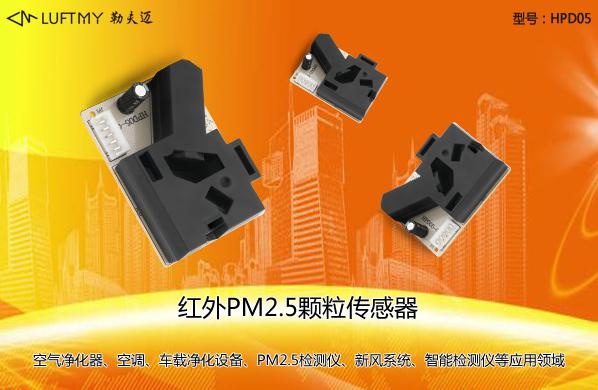
The HPD05 infrared particulate sensor utilizes the optical scattering principle to detect the concentration of dust in the air. The sensor has a built-in infrared light-emitting diode and a high-sensitivity photoelectric receiving sensor. The light emitted by the infrared LED produces reflected light when it encounters dust. The photoelectric sensor detects the intensity of this reflected light to reflect the dust concentration in the air. The sensor directly outputs a PWM signal, where the PWM width represents the current concentration value. It can also output dust concentration values via IIC serial signals in units of ug/m3. The HPD05 smoke particulate sensor has stable detection capability and high production efficiency, offering dual advantages. The LUFTMY dust concentration detector sensor HPD05 features small size, high precision, low power consumption, short response time, and the ability to operate stably under high dust concentrations. This dust detection sensor can be applied in air purifiers, PM2.5 detectors, etc.
