Technical Support:
158-7527-1139

With the rapid development of industrialization and urbanization in China, energy consumption has gradually increased. During this modernization process, many environmental issues arise, the most significant of which is air quality. Atmospheric pollution is becoming increasingly severe and transitioning toward complex pollution. PM2.5 pollution has intensified, leading to frequent smog and reduced visibility. Furthermore, air temperature and humidity levels have become unstable. Consequently, environmental protection agencies across the country have been taking measures to improve air quality.
The most common practice for improving air quality in various regions is the installation of air environmental quality monitoring stations in different areas. These stations provide real-time reflections of the local Air Quality Index (AQI). However, for air monitoring in specific fields—such as urban mobile environment monitoring, emergency air quality monitoring after sudden incidents, or unscheduled inspections of key polluting enterprises—these ground-based stations often struggle to monitor special environments due to limited coverage.

In these cases, portable air quality testing instruments are needed to monitor mobile areas. Air quality monitors use sensor components to monitor polluting gases as well as temperature and humidity. Dust PM2.5 monitoring utilizes the principle of light scattering. Through an automatic sampling and analysis mode, it can simultaneously monitor the concentrations of gases and PM2.5. The concentration results are displayed on a screen, and the average values for corresponding periods can be calculated and stored. The stored data can be uploaded to a computer via the USB interface on the instrument for further data analysis.
Regarding the sensors used in air quality monitors, LUFTMY has found that the most commonly used are PM2.5 sensors and temperature/humidity sensors. This is because monitoring PM2.5 and temperature/humidity in the air is fundamental and serves as a vital indicator for determining if the air is healthy to breathe. In this regard, LUFTMY's laser PM2.5 sensor LD10 is very suitable for air quality monitors, with details as follows:
The LD10 laser particulate PM2.5 sensor is a small module that uses the scattering principle to detect dust particles in the air. It features a small size, high detection accuracy, good repeatability, high consistency, real-time response for continuous sampling, strong anti-interference capability, and uses an ultra-quiet fan. Each sensor undergoes 100% inspection and calibration before leaving the factory.
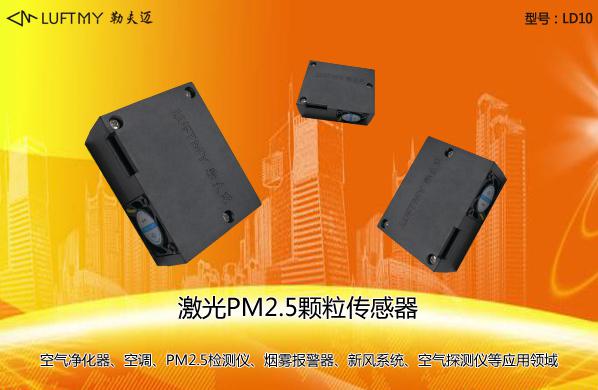
The LUFTMY PM2.5 air quality detection module LD10 is a high-precision PM2.5 particulate matter concentration sensor based on Laser Mie Scattering theory. It can continuously collect and calculate the number of suspended particles of different sizes in the air per unit volume (i.e., particle concentration distribution), then convert them into mass concentration and output them via a universal digital interface. This PM2.5 particulate laser sensor can be embedded in various instruments or environmental improvement equipment related to suspended particulate concentrations, such as air quality testers and air detectors, providing timely and accurate concentration data.