Technical Support:
158-7527-1139

Anyone who has worked in a factory knows that many workers wear masks for protection because most production processes generate dust. To protect worker health and product quality, most factories now install PM2.5 sensors to monitor harmful particles.

Since it is difficult to infer air quality from abstract concentration data, the Air Quality Index (AQI) was created to convert various pollutants into a unified index. PM2.5 refers to fine particulate matter with an aerodynamic diameter of 2.5 microns or less. These particles can remain suspended for long periods; higher concentrations mean worse pollution. Although PM2.5 is a small part of the atmosphere, it significantly affects visibility and health. Due to its small size and high activity, PM2.5 easily attaches to toxic substances like heavy metals and microorganisms.
Particularly in factories, PM2.5 particles are abundant. Monitoring dust concentration is a vital measure for evaluating labor hygiene and technical effectiveness. Since dust is a major cause of occupational diseases, managing it is a crucial aspect of labor health and pollution control.
To prevent inhalation of harmful particles, a PM2.5 sensor, also known as a dust sensor, is required. Luftmy recommends the LD13 laser PM2.5 sensor. It uses the Mie scattering principle: a laser irradiates suspended particles, a detector collects the scattered light, converts it to voltage, and a processor calculates particle size and quantity per unit volume based on Mie theory.
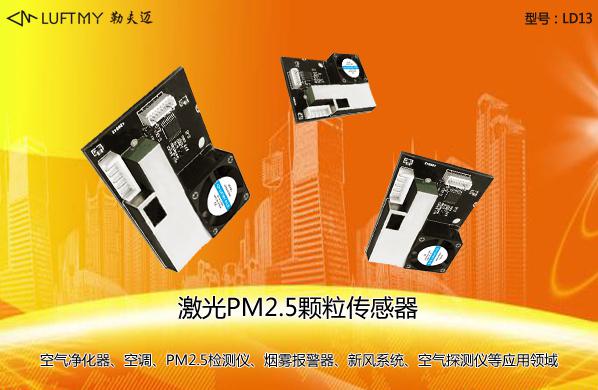
The LD13 laser PM2.5 sensor features high anti-interference, anti-dust accumulation, low noise, and low power consumption. It is suitable for air purifiers, air conditioners, fresh air systems, and specialized detectors.