Technical Support:
158-7527-1139

HVAC system, also known as air conditioning system, includes functions such as temperature, humidity, air cleanliness, and air circulation. Next, let's learn about the related applications of PM2.5 sensor GPS in MHVAC control systems with the editor from Luftmy.
The working principles of HVAC systems and air conditioners providing cooling, heating, or dehumidification are similar. They use refrigerant under the action of a compressor to cause evaporation or condensation, which triggers the evaporation or condensation of surrounding air to achieve the goal of changing temperature and humidity. In the past, HVAC systems were all manually started, requiring switches to be turned on when needed and manually turned off when not. The main issues were a lack of intelligence and energy inefficiency. Modern HVAC systems are generally more intelligent, equipped with various sensors such as temperature, humidity, and dust sensors. When the data detected by the sensors reaches the system threshold, the corresponding adjustment functions will start. Once the environment reaches a suitable state, it returns to standby mode, which is much more convenient and energy-efficient.

The application of PM2.5 sensors within these systems is to monitor the concentration of particulate pollutants in real-time. Their output signals can be fed into the HVAC control systems of buildings, homes, or air monitors to prompt a series of measures to improve air quality, such as starting air purification systems, bringing in outdoor air to purify indoor air, replacing air filters, or performing early maintenance on indoor air delivery systems.
Luftmy's PM2.5~PM10 infrared sensor series products are specialized sensors for PM2.5/PM10.0. They feature strong performance consistency and high precision. By using optical methods to detect dust concentration, these sensors have greatly improved their ability to detect ultra-fine particles, measuring particles from 0.3 to 10.0 microns. This makes them more accurate than traditional sensors in estimating PM2.5/PM10.0 weight concentration values.
Luftmy's infrared air sensor HPD05 dust sensor contains an infrared light-emitting diode and a light-receiving sensor with intersecting optical axes. When a dusty airflow passes through the intersection area, the dust reflects the infrared light, and the intensity of the reflected light is proportional to the dust concentration. The light-receiving sensor detects the reflected infrared light, and through signal conditioning circuitry, outputs the measured dust concentration via PWM or UART. This method is simple, reliable, and relatively low-cost, making it very suitable for this smart fresh air ventilator.
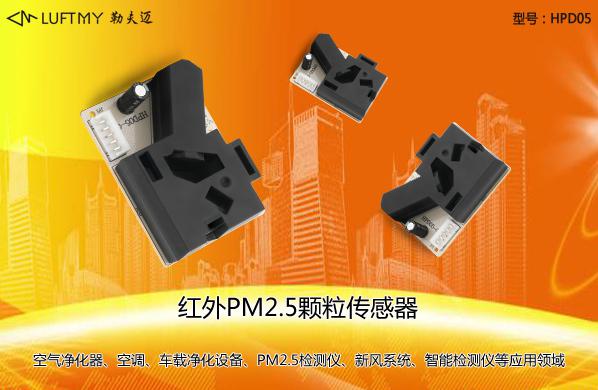
The working principle of the Luftmy infrared sensor HPD05 is based on optical scattering to detect dust concentration. The HPD05 infrared particulate sensor has the dual advantages of stable detection capability and high production efficiency. It features small size, high precision, low power consumption, short response time, and the ability to operate stably under high dust concentrations. This infrared particle sensor can be applied in air purifiers, dust detectors, HVAC systems, etc.