

Technical Support:
158-7527-1139

Do you know where PM2.5 is more severe? Many people believe that the outdoor environment is the main source and that staying indoors is fine. However, this is not the case. Recently, a research team led by Zhao Bin, a professor in the Department of Building Technology at the School of Architecture, Tsinghua University, conducted a systematic study. They believe that working in a high-concentration PM2.5 environment, whether for a short or long stay, will cause damage to the respiratory and cardiovascular systems, which is very unhealthy.
Zhao Yuejing, a member of the research team and a graduate student in the Department of Building Technology at Tsinghua University, said that cooking involves many chemical reactions. Traditional Chinese cooking, in particular, frequently uses stir-frying, pan-frying, and deep-frying. During this high-temperature treatment of food and oil, many organic components in the ingredients thermally decompose, generating a large amount of fine particulate matter and harmful gases. At the same time, the moisture in the food rapidly vaporizes, expands, and partially condenses into mist, forming oil fumes together with the volatiles of the cooking oil.
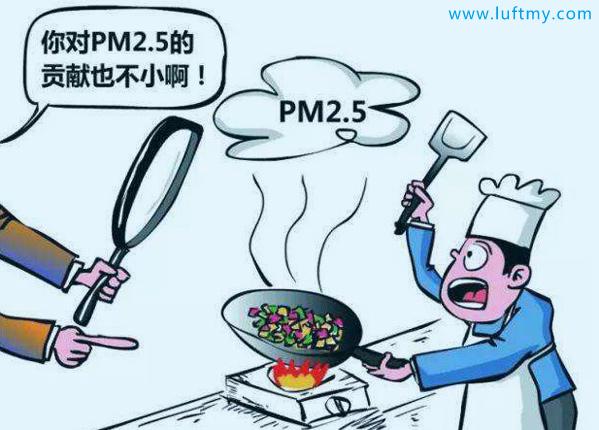
According to expert research, the average PM2.5 concentration in the kitchen during cooking can increase dozens or even hundreds of times, reaching hundreds or even thousands of micrograms per cubic meter (a PM2.5 concentration above 250 micrograms per cubic meter is considered severe pollution).
Since there is so much PM2.5 in the kitchen, it is very important to place a PM2.5 detector with a built-in PM2.5 sensor in the kitchen to monitor the concentration in real-time. So, how can we control it? We can't stop cooking forever. In fact, controlling indoor PM2.5 concentration is simple. Here are a few tips summarized by Luftmy editors—let's learn them together.
First, you can focus on clean fuels. Cooking with gas stoves or induction cookers is healthier.
Second, stir-frying and pan-frying emit more than 40 times the weight of PM2.5 compared to steaming and boiling in the same amount of time. It is recommended to choose "milder" methods like steaming and boiling more often.
The timing of putting ingredients into the pan is crucial. Some people wait until the oil starts smoking noticeably before adding food. At this point, the oil temperature has actually exceeded its "smoke point," and the fumes produced contain various harmful substances, including carcinogens. Compared to keeping the oil temperature below the smoke point, the weight of PM2.5 emitted in the same amount of time can be over 300 times higher! The recommended oil temperature is "medium-hot" (50-60%), which means adding the ingredients when the oil surface ripples more intensely but before smoke starts to form.
Finally, the type of cooking oil also matters. Studies have found that when oil is heated above its smoke point, olive oil emits the most PM2.5 per unit of time among several commonly used cooking oils.
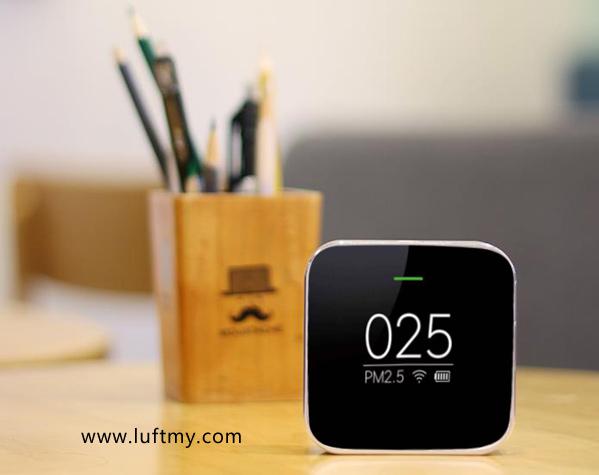
The PM2.5 detector is a dedicated instrument for measuring PM2.5 (fine particulate matter) values in the air. It is suitable for measurement in public places, atmospheric environments, indoor air, and vehicle interiors, and can also be used for the evaluation and analysis of air purifier purification efficiency. Air monitors, indoor air monitors, and handheld particle counters use the laser PM2.5 sensor developed and produced by Luftmy based on the Mie scattering principle. It adopts the PSO particle swarm algorithm to invert particulate matter mass concentration, ensuring fast and accurate data reading.
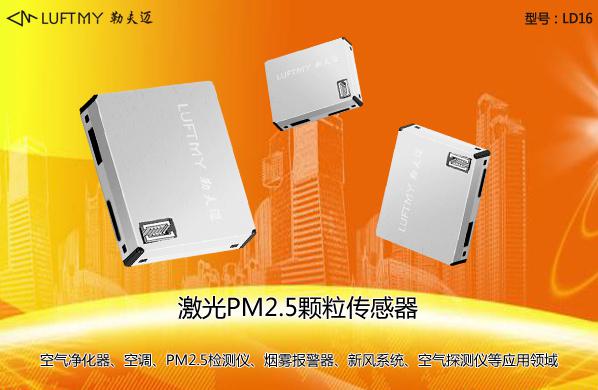
Luftmy, a manufacturer of laser dust sensors, presents the LD16 miniature laser PM2.5 sensor. It is a high-precision particulate matter concentration sensor based on the laser Mie scattering theory. It can continuously collect and calculate the number of suspended particles of different sizes in the air per unit volume, i.e., the particle concentration distribution, and then convert it into mass concentration, outputting it in the form of a general digital interface. The Luftmy LD16 miniature laser PM2.5 sensor features small size, high precision, strong anti-interference ability, low power consumption, long lifespan, zero false alarm rate, and short response time. This miniature laser PM2.5 sensor can be embedded in various instruments or environmental improvement equipment related to suspended particulate matter concentration, such as air monitors, indoor air monitors, and handheld particle counters, providing timely and accurate concentration data.
