

Technical Support:
158-7527-1139

The atmospheric environment on which humans rely for survival is filled with the oxygen necessary for breathing. However, it also contains harmful particulate matter such as PM2.5, which originates from vehicle exhaust, industrial emissions, construction dust, waste incineration, etc. These particles imperceptibly erode human health, causing minor discomfort at best and malignant diseases such as cancer at worst.
Haze is a weather phenomenon where a large collection of tiny dust, smoke, or salt particles suspended in the atmosphere make the air turbid and reduce horizontal visibility to less than 10 kilometers. As “haze weather” continues to appear, air pollution has seriously endangered our health. Consequently, air purification products have continuously entered the market with high sales, the most typical being the air purifier.
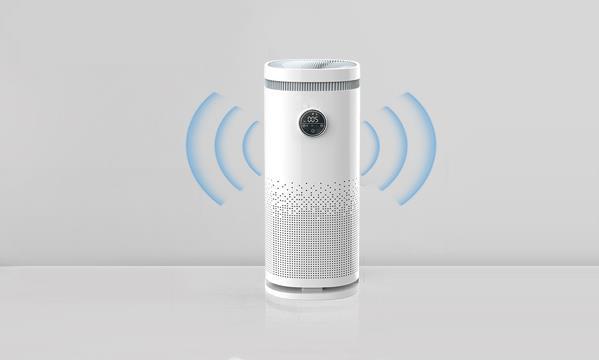
In many cases, the human eye and nose alone cannot identify the presence and content of various particles in the air. However, with technological progress, sensors have endowed humans with unprecedented capabilities. Sensors are like extensions of the five human senses, capable of precisely identifying environmental temperature, humidity, and the specific composition of surrounding air. They have been widely used in national defense, industry, geology, environmental protection, and even daily life. Especially with the raging haze and the strengthening of environmental awareness among the public, air purifiers containing PM2.5 dust sensors have a broad market.
There are many types of air purifiers, and classifications vary by nature. They are simply divided into physical purification and chemical purification. Physical purification involves adsorption, such as HEPA filters and activated carbon adsorption; chemical purification involves decomposition, primarily targeting harmful gases. The technical principle is high-energy particle oxidation. Of course, the sensors used for front-end signal collection and detection are basically the same, generally utilizing air quality sensors and PM2.5 dust sensors.
The progress of “sensor technology” is closely related to people's understanding of “air quality (the types and degrees of air pollution)” and the evolving needs of the era. In the field of smart homes, people pursue a quality life, and one requirement is that the use of various smart home products provides a certain level of comfort. Humanized detail design is an expression of a smart home brand's pursuit of excellence and consideration for customers. Current air purifiers on the market generally have three types of sensors: temperature and humidity sensors, dust sensors, and odor sensors.
It is currently difficult for sensors on the market to measure indoor air quality very accurately. On one hand, there is the accuracy issue of the air quality sensor itself; on the other hand, due to air fluidity and non-uniform distribution of pollutants, it is difficult to satisfy the determination of PM2.5 and TVOC values in a certain space relying on a single sensor.
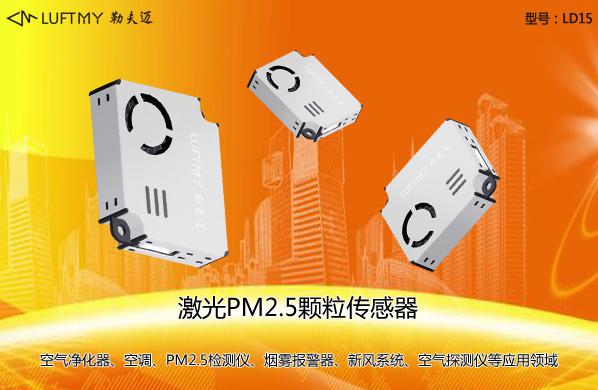
LUFTMY recommends the PM2.5 dust laser sensor LD15. Overview of LUFTMY laser air dust sensor LD15:
The LUFTMY dust PM2.5 concentration sensor LD15 is a high-precision particulate matter concentration sensor based on the Laser Mie scattering theory. It can continuously collect and calculate the number of suspended particles of different sizes in the air per unit volume, i.e., the particulate matter concentration distribution, which is then converted into mass concentration and output via a universal digital interface. The LUFTMY miniature PM2.5 dust sensor LD15 features small size, high precision, continuous sampling, strong anti-interference ability, low power consumption, long life, zero false alarm rate, and short response time. This dust and particulate sensor can be embedded in various instruments or environmental improvement equipment related to suspended particulate matter concentration, such as air purifiers and air detection equipment, providing timely and accurate concentration data.
