

Technical Support:
158-7527-1139


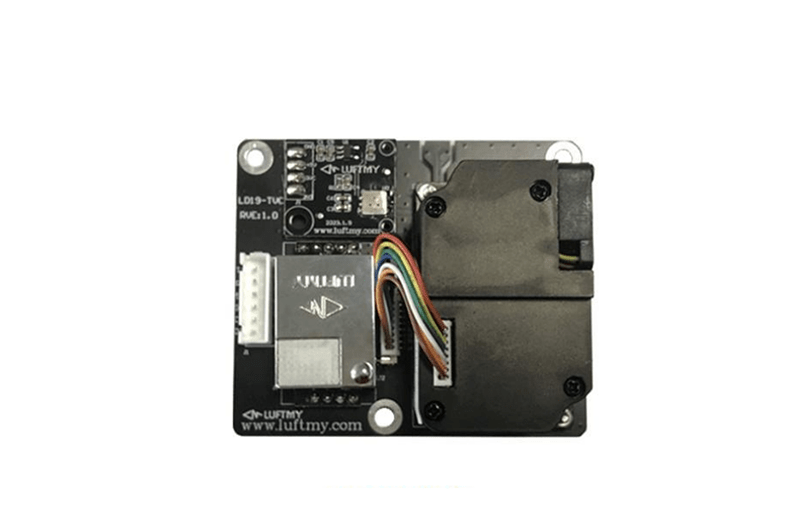
With the increasing emphasis on indoor air quality, the application of air quality sensors is becoming more widespread. An all-in-one air quality sensor refers to a sensor that integrates multiple sensors into one unit, capable of measuring various air quality indicators simultaneously. It features a small size, low power consumption, and low cost, showing broad application prospects in the field of indoor air quality monitoring.
Working Principle:
An all-in-one air quality sensor usually consists of multiple sensors, each responsible for measuring one or several air quality indicators. Common sensor types include:
● Particulate Matter Sensor: Used to measure the concentration of particles in the air, typically using principles such as laser scattering or photoelectric methods.
● Carbon Dioxide Sensor: Used to measure the concentration of CO2 in the air, usually based on infrared absorption or chemical absorption principles.
● TVOC Sensor: Used to measure the concentration of Volatile Organic Compounds in the air, typically using semiconductor resistive or optical-chemical principles.
● Temperature and Humidity Sensor: Used to measure air temperature and moisture levels.
The working principle of an all-in-one air quality sensor involves passing the gases in the air through the sensor to generate a response signal. Then, through a signal processing circuit, the response signal is processed to obtain the numerical values of the air quality indicators.
Application Scenarios:
The all-in-one air quality sensor can be used in the following scenarios:
● Indoor Air Quality Monitoring: It can be used for air quality monitoring in indoor environments such as homes, offices, schools, and hospitals, providing people with real-time and accurate air quality data.
● Industrial Environmental Monitoring: The all-in-one air quality sensor can be used for monitoring air quality in industrial environments to ensure safety in industrial production.
● Environmental Monitoring: It can be used for air quality monitoring in urban and rural environments, providing data support for environmental management by government departments.
Advantages:
The all-in-one air quality sensor has the following advantages:
● Small Size: It usually adopts an integrated design, which is compact and easy to install and use.
● Low Power Consumption: Designed with low power consumption, it can operate for a long time.
● Low Cost: The price is relatively low, making it suitable for large-scale applications.
Development Trends
With technological progress, the all-in-one air quality sensor will develop in the following directions:
● Wider Measurement Range: It will be able to measure more air quality indicators, providing more comprehensive data.
● Higher Measurement Accuracy: The precision will continue to improve, providing more reliable data.
● Lower Prices: The cost will be further reduced, making it acceptable to more people.
The all-in-one air quality sensor is a “powerful tool” in the field of indoor air quality monitoring. With technological advances, it will be applied in more scenarios, providing protection for people's health and life.
