

Technical Support:
158-7527-1139

According to relevant foreign media reports, Hyundai Motor Group announced the development of a “Smart Air Purification” system that can monitor in-car air quality and automatically filter the air inside the vehicle. The system continuously detects the air quality inside the car until it reaches the “Excellent” level as defined by Hyundai.

The system utilizes advanced filtration innovation technology to automatically clear fine particulate matter before passengers enter the car and continues to filter the air throughout the journey, ensuring comfort for passengers, especially those with allergies. Furthermore, passengers can monitor the in-car air quality in real-time through the Audio Video Navigation (AVN) screen inside the vehicle.
Hyundai has categorized air quality based on the standards of the Korea Environment Corporation, which divides air quality into four levels: Excellent, Good, Fair, and Poor, based on the quantity of fine particles. While traditional air purification systems only run for a period of time before shutting off, Hyundai's “Smart Air Purification” system constantly monitors the in-car air quality and activates the purification function if the quality drops to the “Fair” level. It continues to purify the air until the quality becomes “Excellent.” Hyundai stated that even if the external air quality is “Poor,” the system can purify the in-car air to “Excellent” in a very short time.
Ordinary air monitoring sensors are prone to reliability issues due to the gradual accumulation of fine particles on the measurement lens. Hyundai Motor has designed an integrated laser sensor to measure particulate matter levels in the air, ensuring the system's durability and reliability.
The smart air purification system has undergone rigorous testing to ensure that the purifier's fan motor and sensors function properly in extreme heat and cold environments. Its high-performance air filter can increase the absorption rate of fine particles from 94% to 99%. Additionally, the system features a charcoal deodorizing function and can automatically close car windows to speed up the purification process.

The head of the FR Interior and Exterior System Engineering Design Team stated, “Even in highly polluted areas, we can provide our customers with the cleanest air to breathe, demonstrating Hyundai Motor Group's commitment to caring for its customers. This innovation is one of our projects dedicated to providing customers with the best in-car environment.” The company is considering installing the new air purification system in future Hyundai and Kia models to reduce the health impact of fine particles and alleviate concerns, especially in highly congested urban areas.
The primary means of detecting and monitoring particulate matter is through PM2.5 particulate matter sensors. The PM2.5 sensor brand LUFTMY focuses on the research, production, and sales of optical particulate matter sensor technology. Guided by the corporate culture of “Craftsmanship Dreams” and adhering to the service tenet of “Customer First,” LUFTMY holds a high market share in both domestic and international PM2.5 sensor markets. LUFTMY's laser dust particulate matter sensors and other sensors have received widespread acclaim in the industry for multiple performance indicators such as measurement accuracy, stability, consistency error, and anti-interference capability.
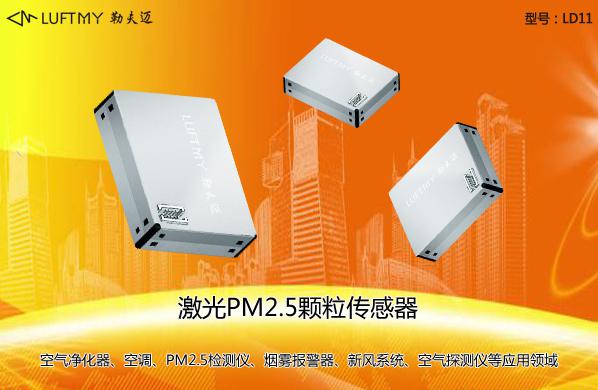
The LUFTMY laser dust particulate matter sensor LD11 is a high-precision particulate matter concentration sensor based on the Laser Mie scattering theory. It can continuously collect and calculate the number of suspended particles of different sizes in the air per unit volume, i.e., the particulate matter concentration distribution, which is then converted into mass concentration and output via a universal digital interface. The LUFTMY dust particulate matter sensor LD11 features small size, high precision, strong anti-interference ability, low power consumption, long life, zero false alarm rate, and short response time. This dust particulate matter sensor can be embedded in various instruments or environmental improvement equipment related to suspended particulate matter concentration, such as air purifiers, air detection equipment, and in-car air quality monitoring devices, providing timely and accurate concentration data.
