Technical Support:
158-7527-1139

What is particulate matter PM2.5?
PM is the abbreviation for Particulate Matter suspended in the air. Particles with a diameter of 2.5 micrometers or less are called PM2.5, also known as fine particulate matter. PM2.5 poses a greater threat to human health as it easily accumulates deep in the lungs, thus it is also called lung-penetrating particles. It can stay suspended in the air for long periods; the higher its concentration, the more serious the air pollution.
During frequent haze weather, PM2.5 air pollution and dust become issues that cannot be ignored. Furthermore, with traffic congestion and the increase in car ownership, the degree of air pollution also intensifies.
How to improve air quality?
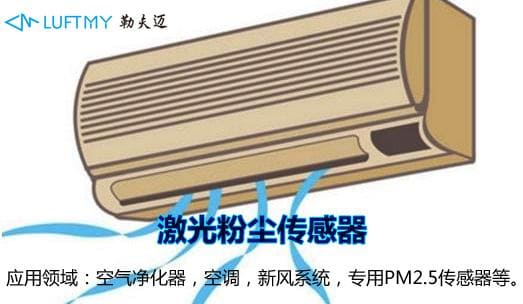
To ensure good indoor air quality, air conditioners and purifiers have become the first choice for most people. Many air conditioners on the market are now equipped with PM2.5 sensors and have filtering and dust removal functions, which can greatly improve indoor air quality. The working principle of the PM2.5 dust sensor in air conditioners lies in the silver ion electrostatic precipitator. When the dust content in the air is too high, the silver ion electrostatic precipitator starts automatically, using high-voltage electrostatic technology to adsorb dust onto the collection plates and filters.
Air quality conditions affect the standard of home living. While many air conditioners are equipped with filters and dust removal functions, these seem insufficient to meet consumer needs in environments where air quality is declining. Adding PM2.5 sensors to air conditioners has become a new trend.
Why add PM2.5 dust sensors to air conditioners?
The development trend of PM2.5 sensors applied in air conditioning purification.
With the development of industrialization and informatization, modern PM2.5 dust sensors can monitor PM2.5 and PM10 particles simultaneously, providing real-time monitoring of indoor and outdoor dust concentrations.
After adding PM2.5 dust sensors, the air conditioner can refresh indoor air based on monitored dust data. In addition, fan intake can be controlled based on this data to meet energy-saving and environmental protection requirements.
Therefore, adding PM2.5 dust sensors to keep people away from dust pollution will become a new trend in future air conditioning development.