Technical Support:
158-7527-1139

Dust concentration sensors are primarily used for continuous monitoring of dust levels in indoor environments and other workplaces. To meet current indoor air quality requirements, high-tech sensors have been developed for real-time monitoring of dust concentration based on light scattering theory in natural airflow states.
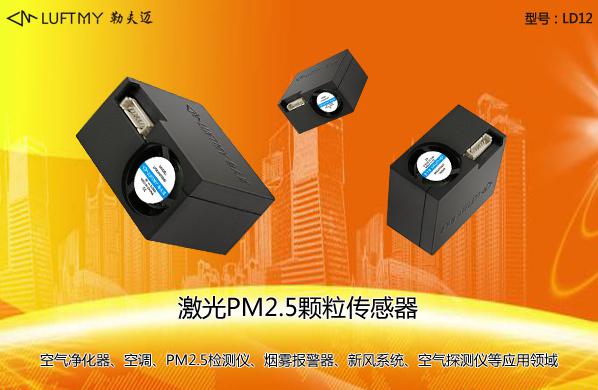
Detailed Introduction of Domestic PM2.5 Fine Particulate Dust Sensor
The LD12 laser dust sensor (dust detector) is a high-tech product independently developed by Guangzhou LUFMES, integrating aerodynamics, digital signal processing, and opto-mechatronics. It is mainly used to detect the mass concentration of atmospheric dust (PM values) and is suitable for indoor air testing, urban grid monitoring, mobile monitoring, and other fields, serving as a core module for atmospheric quality detection systems.
Parameter Specifications of Domestic PM2.5 Fine Particulate Dust Sensor
Accurate Data: Laser principle detection with industrial-grade photoelectric sensing; High Resolution: ≥0.3um particle size, 0.001mg/m3;
Detection Range: PM1.0~PM10;
Stable Performance: Adaptable to different atmospheric dust compositions with independent parameter coefficient adjustment;
Data Transmission: UART, PWM;
Intelligent Monitoring: Real-time monitoring of sensor indicators with timely user feedback in case of abnormal states;
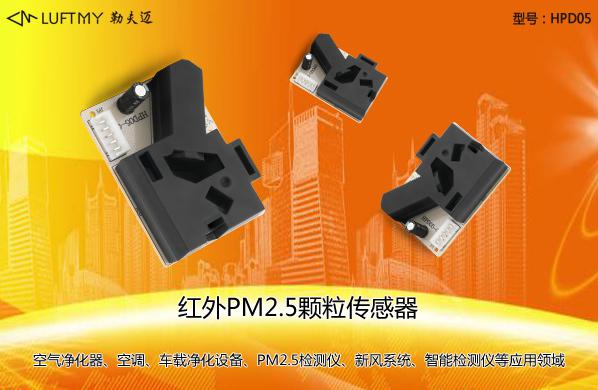
Product Introduction of Domestic PM2.5 Fine Particulate Dust Sensor
Dust concentration sensors are mainly used for continuous monitoring of total dust concentration in indoor monitoring locations and are core modules of atmospheric quality detection systems.
Structural Principle of Domestic PM2.5 Fine Particulate Dust Sensor
The structure and circuitry of infrared principle PM2.5 dust sensors are relatively simple. The light source is an infrared LED, and airflow is primarily driven by resistive heating to generate thermal airflow. High levels are output when particles pass through. Output signals are limited to PWM and IIC.
The PM2.5 sensor brand LUFMES infrared PM2.5 sensor module HPD05 uses the principle of optical scattering to obtain particle concentration. Through optical and circuit conversion, it measures the dust concentration within the detection range. The LUFMES HPD05 features small size, high precision, low power consumption, short response time, and stable operation under high dust concentrations. This infrared dust sensor can be applied in air purifiers, fresh air systems, etc.
Difference between laser and infrared dust sensors: The structure and circuitry of laser PM2.5 sensors are relatively complex, using a laser diode as the light source. Sampling air is pushed by a fan or blower through a complexly designed duct for detection. When fine particles in the air enter the laser beam area, they cause the laser to scatter. Scattered light radiates 360° in space; we place photoelectric detectors in appropriate positions to receive only the scattered light. Current signals are generated via the photoelectric effect, which, after amplification and processing, provide the fine particulate concentration value. Output is generally via serial port, with some manufacturers simultaneously outputting various particle sizes like PM10 and units like pcs/l and mg/m3.
Price of Domestic PM2.5 Fine Particulate Dust Sensor:
Infrared dust sensors have been maturely used in the industry for years, with market prices around dozens of yuan. Laser dust sensors are newly emerging. The cost gap is mainly due to the latter requiring laser generators, fans, complex circuitry, and having higher technical barriers.
Measurement Accuracy Difference: Infrared sensors can only detect particles larger than 1 micron, leading to insufficient accuracy. Because infrared LED scattering signals are weak, they only respond to large particles and rely on heating resistors to drive airflow, resulting in fewer samples and relying on the host computer for calculations. Laser sensors can detect particles above 0.3 microns. With high-performance CPUs and fans/blowers for large data collection analyzed by professional particle counting algorithms, laser sensors outperform infrared ones in sampling count, data sources, and algorithms.
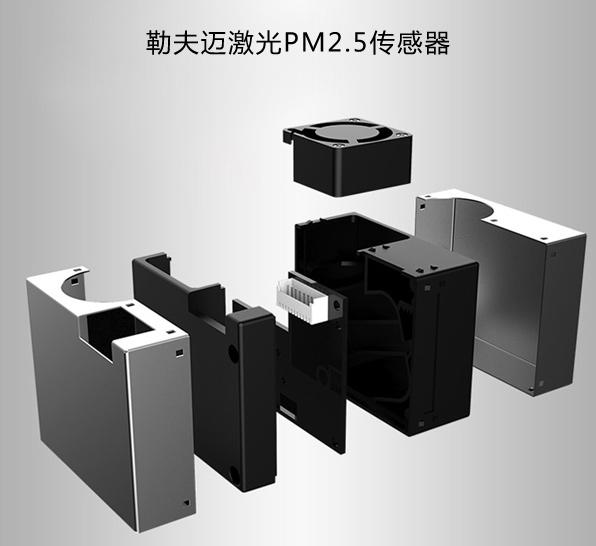
Application Scenarios: Due to accuracy limitations, infrared sensors are mainly used for indoor mining dust detection targeting large-diameter, high-concentration dust (measured in mg/m3), and cannot accurately measure PM2.5. Laser sensors are primarily used in the PM2.5 detection field to quantify quality with precision. They can be embedded in household (car, handheld) air detectors and air purifiers. Additionally, laser sensors are used in IoT data collection and environmental quality testing.
Trends: Before laser sensors entered the civilian field, infrared PM2.5 modules were widely used in air purifiers. However, as the industry evolves, the cost of high-sensitivity laser sensors is gradually decreasing, and terminal customers are demanding more precise measurements. Using laser sensors to accurately quantify PM2.5 quality is now the recognized industry trend.