Technical Support:
158-7527-1139

There are many types of laser sensors on the market, and different types of laser sensors have unique principles. Laser PM2.5 sensors are characterized by universality, miniaturization, accurate data, and real-time response. They can be applied in portable instruments, air quality monitoring equipment, air purifiers, fresh air ventilation systems, air conditioners, smart home devices, and other locations.
Infrared LEDs are light-emitting diodes that emit wavelengths in the infrared range, with common wavelengths generally around 850nm to 940nm. They are widely used in medical, security, communication, remote control, and sensing fields. Since the infrared LED emission wavelength is outside the visible spectrum, combined with a receiver of a specific spectrum, the impact of ambient light on the received signal can be significantly weakened. Thanks to the continuous maturation of infrared LED technology in recent years, infrared LEDs feature long life, high emission efficiency, good monochromaticity, and good directionality. This has led to the extensive use of infrared LEDs in the sensor field, especially in the dust sensor industry.
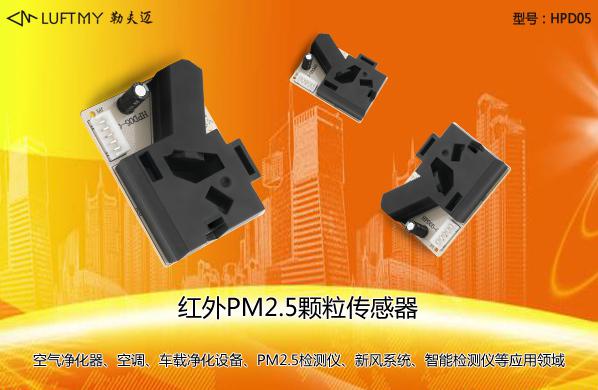
The dust sensor brand Luftmy's infrared dust sensor HPD05 utilizes the principle of optical scattering to obtain particle concentration. Through the conversion of optical paths and circuits, it measures the dust concentration within the detection range. Infrared dust sensor supplier Luftmy's infrared counter-beam counting sensor HPD05 features small size, high precision, low power consumption, short response time, and stable operation under high dust concentrations. This sensor can be applied in air purifiers, fresh air systems, etc.
Setting aside obscure physical terms, compared with ordinary visible light, laser has the characteristics of high coherence, strong directionality, good monochromaticity, and high power density. To use a vivid analogy, the light produced by a laser source is like a chorus where everyone's voice is the same tone and the rhythm is orderly; whereas the light produced by an ordinary visible light source is like the noisy chatter in a teahouse—unorganized and disordered. Therefore, lasers can be converged into very concentrated parallel beams and can maintain a small diffusion angle and high power density over long distances. Common lasers are generally divided into three categories: solid-state lasers, gas lasers, and semiconductor lasers (commonly known as laser LEDs). In the field of instrument-grade laser particle counters, (He-Ne) gas lasers are generally used as the light source.
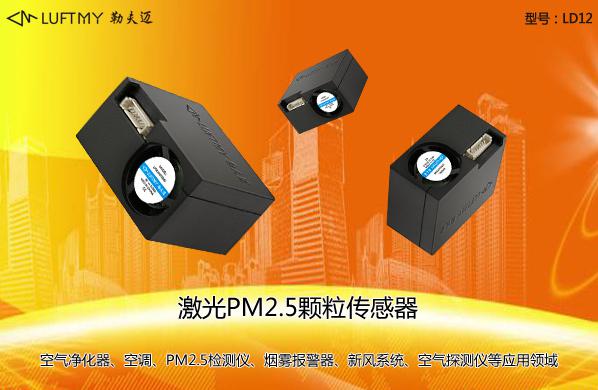
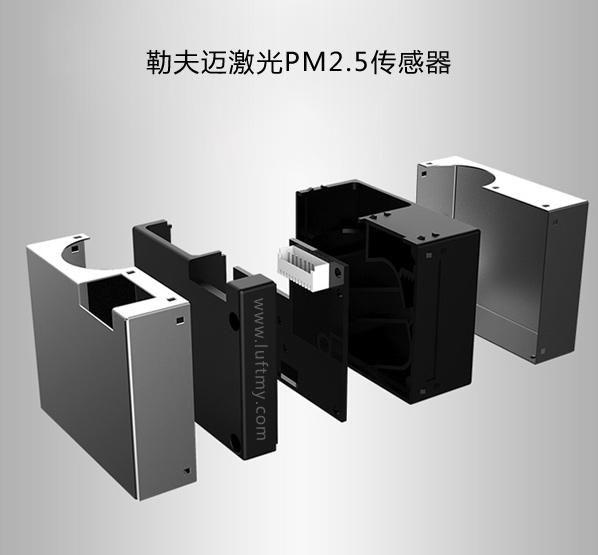
Dust sensor brand Luftmy's miniature laser PM2.5 sensor module LD12 is a high-precision particle concentration sensor based on Laser Mie Scattering Theory. It can continuously collect and calculate the number of suspended particles of different sizes in the air per unit volume, i.e., the particle size distribution, which is then converted into mass concentration and output in the form of a universal digital interface. Luftmy's miniature laser PM2.5 sensor LD12 features small size, high precision, strong anti-interference capability, low power consumption, long life, zero error alarm rate, and short response time. This high-quality laser PM2.5 sensor can be embedded in various instruments or environmental improvement equipment related to suspended particle concentration, such as fresh air systems and air purifiers, providing timely and accurate concentration data.