

Technical Support:
158-7527-1139

Air purifiers, as the name suggests, are designed to purify indoor air quality and provide a certain level of improvement to the indoor environment. However, the degree of improvement depends on specific standards and follows a certain cycle; this cycle is also related to various factors, such as the filter type and the specific air quality of the room being used.
What is an air purifier?
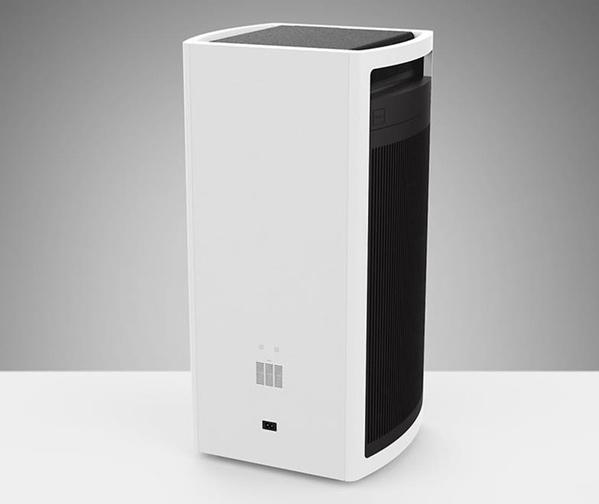
An air purifier, also known as an “air cleaner,” air freshener, or purifier, refers to a product that can absorb, decompose, or transform various air pollutants (generally including PM2.5, dust, pollen, odors, decoration pollution like formaldehyde, bacteria, allergens, etc.) to effectively improve air cleanliness. They are mainly categorized into household, commercial, industrial, and building types.
What are the main functions of an air purifier?
1. Removing particulate matter, such as PM2.5, bacteria, and pollen. Most air purifiers perform well in this regard.
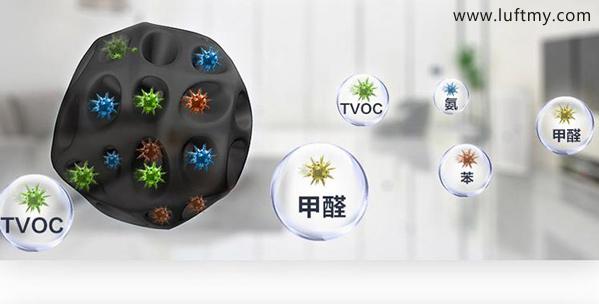
2. Removing gaseous pollutants, such as formaldehyde, benzene, waste odors, and glue or paint smells. Most purifiers are not very effective here, though a small number of professional formaldehyde-removing purifiers show good results.
3. Releasing negative ions (also called water ions, negative oxygen ions, nano-mist, etc., which are essentially similar) to freshen the air.
4. Humidification to increase air comfort.
Why use an air purifier?
Since 2013, we have recognized the power and harm of haze. Many times, PM2.5 levels exceed 300, which can trigger asthma in patients with respiratory diseases. Placing an air purifier indoors can effectively reduce PM2.5 concentration and lower the impact of haze on health. When air quality is poor, using an air purifier indoors is the primary method for haze protection.
Home air purifiers are small household appliances used to solve indoor air pollution issues. Even when outdoor pollution is high, indoor pollutants can persist. Using an air purifier is an internationally recognized method for improving indoor air quality, making it a useful tool. Currently, the mainstream air purifiers on the market are passive adsorption and filtration types. The working principle involves using a fan to draw air into the machine and filtering it through built-in filters to filter dust, eliminate odors, and remove microorganisms.
How effective are air purifiers?
The purification effect of an air purifier is directly related to outdoor air quality, which also affects the lifespan of the device. Since outdoor air enters the room through doors and windows, indoor PM2.5 concentration is significantly correlated with outdoor levels. Higher outdoor concentrations mean more PM2.5 enters the room, increasing the workload of the purifier, which may result in poorer purification effects and a shorter lifespan. Because the principle of an air purifier is similar to a vacuum cleaner, it sucks pollutants into the machine, most of which end up on the HEPA filter. The worse the air quality, the faster the HEPA filter is damaged. If the outdoor air is very dirty, it is recommended to close the outermost windows to minimize convection while allowing some necessary air circulation.
How to use an air purifier effectively?
There are many types of air purifiers on the market today with different functions. Many have filtering effects, but some bacteria may not be killed after being filtered. If these bacteria continue to multiply on the filter, it becomes a source of pollution.
An air purifier filter has a limited capacity. In cases of severe pollution, the filter can become saturated after a few months and needs regular cleaning or replacement. If not cleaned regularly under suitable humidity, bacteria will breed on the accumulated dust, making the purifier a source of pollution rather than a solution.
PS: If you are choosing an air purifier solely for haze, it is economical, portable, and flexible. However, if you are trying to remove formaldehyde in an environment where it exceeds standards, it is better to maintain effective indoor ventilation, which is safer and more effective than using an air purifier.
What kind of air purifier should you buy?
Regarding dust particle purification, indoor particles are generally brought in from outside. Due to differences in climate and emissions between China and abroad, the composition and categories of dust vary. Therefore, standards for particle processing differ. For gaseous pollutants, the types and severity of decoration pollution also vary. Foreign standards for gaseous pollutants may target different substances; for example, Europe and America do not have strict standards, Japanese standards target cigarette smoke, and Chinese standards target toluene and formaldehyde.
Due to the variety of air purifiers, consumers often find it difficult to judge. The basic principles for choosing one are: non-toxic/harmless, safe, and effective. During the purchase process, you must look at the Clean Air Delivery Rate (CADR) and avoid being misled by "removal rate" claims. The removal rate is affected by experimental chambers, running time, and natural decay, making it hard to reflect the true capacity of the purifier.
Overall, although foreign air purifiers may have quality advantages, if they cannot make localized adjustments for China, a domestic air purifier may be more suitable for the Chinese air environment.
What is the role of the built-in PM2.5 sensor in an air purifier?
In the current air purification field, PM2.5 sensors have become standard hardware. Their role is to monitor the concentration of particles like PM2.5 in the air. The principle is as follows: a constant light source (such as an infrared LED) is set inside the sensor. When air passes through the light, particles scatter it, causing light attenuation. The relative attenuation rate is proportional to the concentration of particles. Given the application of PM2.5 sensors in purification equipment, Luftmy recommends the infrared PM2.5 sensor GDS06 and the laser dust sensor LD11:
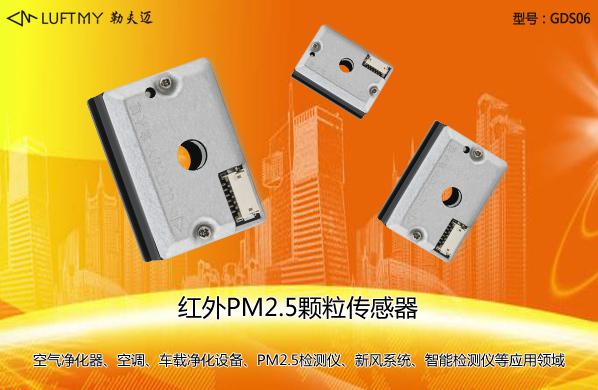
The PM2.5 sensor brand Luftmy provides the infrared dust sensor GDS06, which utilizes the principle of optical scattering to obtain particle concentration. When a beam of parallel monochromatic light enters the measured particle field, it is affected by scattering and absorption, causing attenuation. The relative attenuation rate can represent the dust concentration linearly. The intensity of light is proportional to the electrical signal converted by photoelectric components. By measuring the signal, the concentration can be determined and communicated via PWM or UART using a microcontroller. The GDS06 detects particles as small as 0.3 microns, such as indoor dust, pollen, microorganisms, mites, and cigarette smoke. This dust particle counter is suitable for automatic air monitoring systems in air purifiers and fresh air systems.
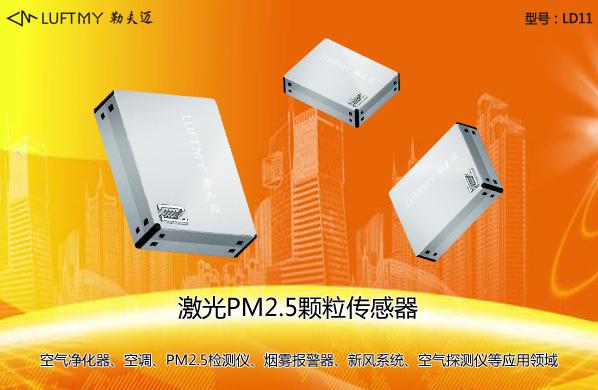
The Luftmy laser particle sensor LD11 is a high-precision sensor based on Laser Mie Scattering theory. It can continuously collect and calculate the number of suspended particles of different sizes per unit volume, outputting the concentration distribution via a universal digital interface. The LD11 features small size, high precision, strong anti-interference, low power consumption, long life, and short response time. This air purifier dust sensor can be embedded in various instruments like indoor air quality monitors and PM2.5 detectors to provide timely and accurate data.
