

Technical Support:
158-7527-1139

Nowadays, air purifiers have become an indispensable household appliance in our lives, but few people can correctly grasp how to choose the right one. The sensor is a very important component of an air purifier, and sensors used by different brands vary greatly. Today, we will discuss the topic of air purifier sensors.
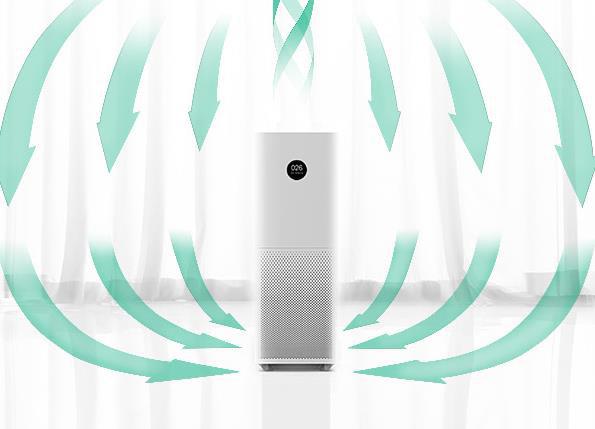
Choosing an air purifier dust sensor is very important
1. Origin of sensor technology
In the 1980s, the primary function pursued by air purifiers was "removing smoke odor." Among sensors, air purifiers were first equipped with "odor sensors," also known as VOC sensors or air quality sensors. The function of an odor sensor is to detect the concentration of "odor" substances floating in the air. When the surface of a sensor made of metal oxide semiconductors adsorbs odor molecules, the electrical conductivity increases and the resistance value decreases. The sensor judges the concentration of odor substances by detecting changes in the resistance value.

An air purifier that can directly display PM2.5 values has appeared on the market. It is understood that it uses a high-sensitivity optical sensor, represented by the brand Luftmy. Generally, air purifiers adopt the latest generation of high-precision laser dust sensors, which can display the PM2.5 concentration of the current indoor environment in real-time. Additionally, the purifier has a built-in microcomputer intelligent management chip that can automatically adjust the indoor air purification and fan speed based on the sensor's identification. All these intelligent operations benefit from high-precision optical sensors.
2. Inaccuracy of dust sensors
Currently, most air purifiers in the top ten air purifier brands market use dust sensors that can sense dust particles in the air but cannot accurately reflect specific values; they can only roughly identify a range. For example, the most common Philips air purifiers use three color indicator lights to display air quality. However, with the upgrading of air purifier purification technology, the application of sensors is becoming more and more precise. Currently, air purifiers use fewer infrared dust sensors and more laser dust sensors.
3. Sensors are the core of air purifiers
As optical dust sensors are applied to air purifier products, more air purifier brands will speed up the replacement of sensors. Ordinary sensors that can only vaguely identify air quality will be eliminated. More purifier brands will realize user needs and update the sensors required for their products.
When researching products, we must grasp where the core technology of the air purifier lies. Only by finding the core essentials can we find a breakthrough point in upgrading products, combine it with market development, and allow the products to go further.
Luftmy PM2.5 Dust Sensor
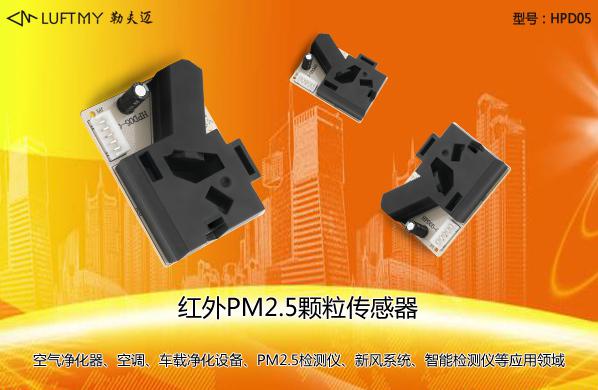
Luftmy, a PM2.5 infrared sensor manufacturer, provides the particulate matter concentration sensor HPD05, which utilizes the principle of optical scattering to obtain particulate concentration. Through the conversion of light paths and circuits, it measures the dust concentration within the detection range. The Luftmy HPD05 sensor features small size, high precision, low power consumption, short response time, and stable operation under high dust concentrations. This sensor can be applied in air purifiers, range hoods, etc. For more dust sensor prices, please consult online.
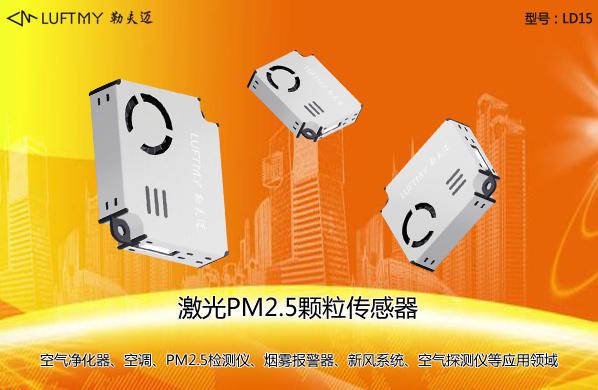
The Luftmy digital particulate sensor LD15 is a high-precision particulate concentration sensor based on laser MIE scattering theory. It can continuously collect and calculate particulate concentration distribution and output it via a universal digital interface. The LD15 laser particulate sensor features small size, high precision, strong anti-interference ability, low power consumption, long life, zero false alarm rate, and short response time. The Luftmy LD15 can be embedded in various instruments related to suspended particulate matter concentration, such as range hoods or environment improvement equipment, providing timely and accurate concentration data.
Luftmy focuses on the research, production, and sales of optical particulate sensor technology. Luftmy sensors are widely praised in the industry for measurement accuracy, stability, consistency error, anti-interference, and other performance indicators.
