

Technical Support:
158-7527-1139

The working principle of dust sensors is developed based on the principle of light scattering. Particles and molecules will produce light scattering phenomena under the illumination of light, while simultaneously absorbing part of the energy of the illuminated light. When a beam of parallel monochromatic light is incident on the particle field under test, it will be affected by scattering and absorption around the particles, and the light intensity will be attenuated. In this way, the relative attenuation rate of the incident light passing through the concentration field to be measured can be obtained. The magnitude of the relative attenuation rate basically reflects the relative concentration of dust in the tested field linearly. The magnitude of the light intensity is proportional to the strength of the photoelectric-converted electrical signal. By measuring the electrical signal, the relative attenuation rate can be found, and subsequently, the dust concentration in the field to be measured can be determined.
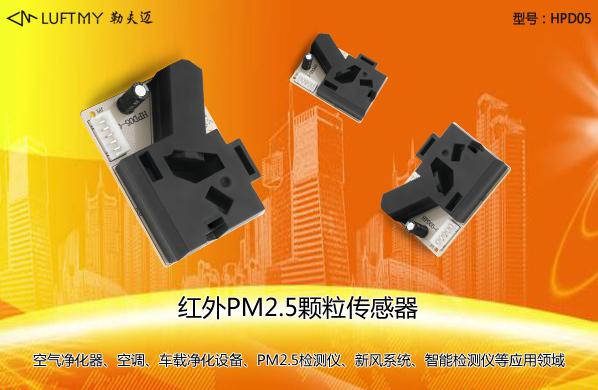
The dust sensor brand LUFMES infrared dust sensor HPD05 utilizes the principle of optical scattering to obtain particle concentration sizes. Through the conversion of the optical path and electrical circuit, it measures the dust concentration within the detection range. The dust sensor supplier LUFMES dust concentration sensor HPD05 features a small size, high precision, low power consumption, short response time, and stable operation under high dust concentrations. This dust concentration sensor can be applied in air purifiers, fresh air systems, etc.
Generally speaking, haze meters costing tens of yuan definitely use infrared dust sensors. This type of sensor determines the concentration of dust particles in the air through light transmittance. The price is very low, generally around a dozen yuan. In a strict sense, it can only detect large particles, so inaccuracies are inevitable. In this case, if you want to buy a relatively reliable haze meter, do not be too greedy for low prices; try to choose a laser dust sensor that is relatively more accurate using the laser scattering principle. The laser dust sensors produced by LUFMES are worth recommending.
In 2013, the suppliers existing on the market included LUFMES, Sainuowei, and Huaman domestically, and internationally, Shinyei (Japan), Sharp (Japan), Samyoung (Korea - representing low-priced products chosen by most copycat manufacturers), and GE (USA). In 2014, the industry developed rapidly, and suppliers began to increase. Shinyei started to have some customers follow up with digital displays; an agent for Sharp began to propose domestic digital displays; GE, with its performance and brand advantages, saw its market share rise continuously, posing a major impact on Shinyei. Due to problems with the agent system, GE began to decline, and the GE sensor division was sold to Amphenol, losing brand awareness. Laser dust sensors led by Plantower began shipping in 2014 and quickly occupied air purification internet brands. Among domestic brands, copycat manufacturers centered in Shenzhen began to emerge constantly, and manufacturers such as Zhengzhou Winsen, Novafitness, and Cubic began to exert their strength. In 2015, the industry was sluggish, and Shinyei's sales volume declined severely. Sharp quickly filled the gap left by Samyoung while replacing some of Shinyei and GE's customers with digital display products. Domestic brands improved their technical strength and services, but market acceptance remained low. In 2018, the SPS30 launched by Sensirion and the HPW series particulate matter sensors from Honeywell both received good market feedback. LUFMES LD series from Guangzhou, relying on price advantages, excellent product performance, and stable supply channels, has seen a rapid rise in particulate matter sensor market share in recent years, enjoying an excellent reputation and high influence within the industry.
Comprehensive requirements and technical bottlenecks of laser dust sensors:
1. Lifespan: The lifespan of a laser emitting tube is several thousand hours, and there is a possibility of sudden failure (around 0.5%). This is a characteristic of laser sensors, so lifespan is something you need to pay special attention to. More critical than the laser sensor is the lifespan of the air pump or fan; a pump's life is only 2000 hours, while the fan's life depends on the design and material selection of the sensor manufacturer.
2. Precision: The advantage of laser sensors is their ability to detect particles in the 0.3~1.0 range, making detection results closer to real values. For accuracy, please do not make an intuitive comparison with TSI; compare it with Meteorological Bureau data. At the same time, we recommend an "Air Quality Index" APP; when comparing, pay attention to finding data from the nearest national monitoring station.
3. Consistency: Taking a batch of 100 sensors as an example, if the average value is 100ug/m3, check the proportion of these 100 sensors deviating from 100ug. Within 10% is considered qualified, and within 5% is excellent. Writing so much is for the reference of the public when purchasing purification products, and also to facilitate engineers from air purifier and fresh air machine manufacturers to choose the infrared or laser dust sensor that best fits their products during design. Because choice is greater than effort, choice establishes the pattern, and choice determines success.
Product Introduction of Domestic Brand LUFMES LD10 Dust Concentration Sensor
The dust concentration sensor LD10 is independently developed by the dust sensor brand LUFMES. It is a high-tech product integrating aerodynamics, digital signal processing, and opto-mechatronics. It is mainly used to detect the mass concentration of dust in the atmosphere (PM value) and is suitable for indoor air detection, urban grid monitoring, mobile monitoring, and other fields and occasions. It is the core module of atmospheric quality detection systems.
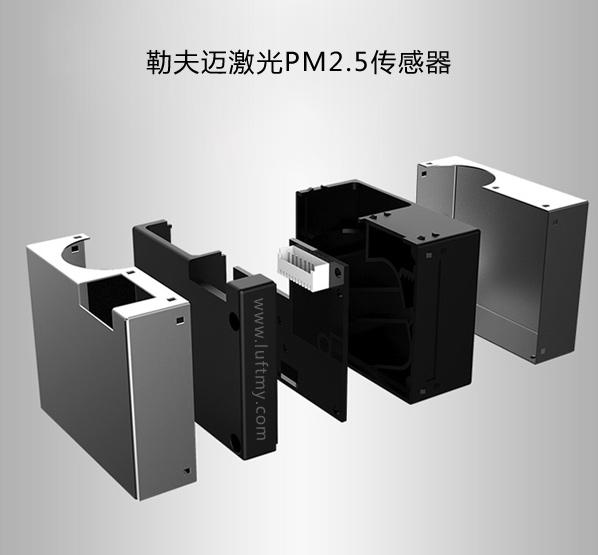
The dust sensor brand LUFMES laser particulate matter sensor LD10 is a high-precision particulate matter concentration sensor based on Laser Mie Scattering Theory. It can continuously collect and calculate the number of suspended particles of different sizes in the air per unit volume, i.e., the particle concentration distribution, and subsequently convert it into mass concentration, outputting it in the form of a general digital interface. LUFMES laser dust particle counter LD10 features small size, high precision, strong anti-interference ability, low power consumption, long life, zero error alarm rate, and short response time. This laser dust particulate particle sensor can be embedded in various instruments related to suspended particle concentration in the air, such as air detectors or environmental improvement equipment, to provide timely and accurate concentration data.
