

Technical Support:
158-7527-1139

In today's environment of environmental protection and health concerns, the detection of PM2.5 (fine inhalable particles) has become increasingly important. PM2.5 is a type of fine particulate matter that significantly impacts air quality and health. To measure and monitor PM2.5, scientists and engineers have been seeking innovative methods. This article will explore whether infrared dust sensors can be applied to PM2.5 detectors, and analyze their advantages and applicable scenarios.
Working principle of infrared dust sensors:
Infrared dust sensors are a special type of sensor that use the principle of infrared radiation to detect particles in the air. These sensors contain a light source and a receiver; the light source emits infrared radiation, while the receiver measures the change in radiation intensity after passing through the particles in the air.
When particles are present in the air, these tiny particles scatter or absorb the infrared radiation, causing a decrease in the radiation intensity measured by the receiver. The sensor determines the particle concentration in the air by measuring the change in radiation, thereby achieving PM2.5 detection.

Advantages of infrared dust sensors:
● High Precision: Infrared dust sensors usually have very high measurement precision and can accurately measure PM2.5 concentration, making them an ideal choice for precise measurement.
● Fast Response: These sensors typically have fast response times and can quickly detect changes in PM2.5 levels, which is helpful for real-time monitoring and control.
● Long Life: The lifespan of infrared dust sensors is usually long, requiring less maintenance and replacement, which reduces operating costs.
● Interference-free: Infrared sensors are less affected by environmental factors and are not easily interfered with by humidity, temperature, and other gas components.
● Wide Application Range: These sensors are suitable for various environments, including indoor and outdoor, and PM2.5 detection under different climatic conditions.
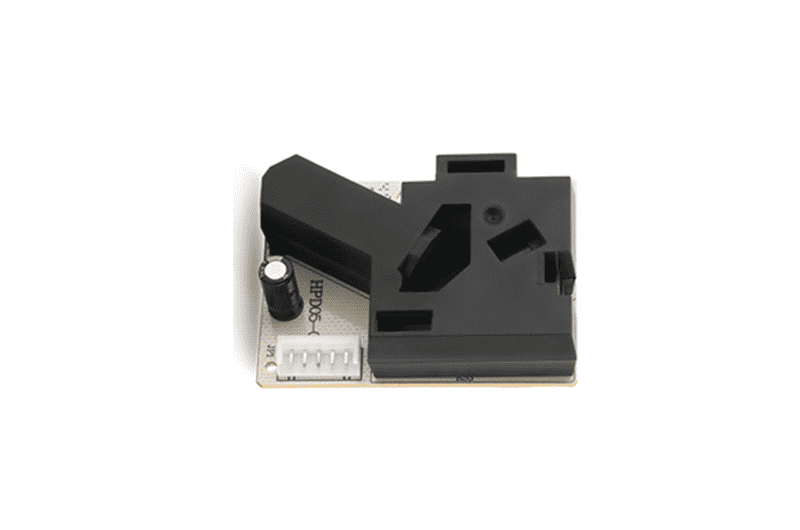
Applications of infrared dust sensors:
● Air quality monitoring: Infrared dust sensors can be used in air quality monitoring stations to monitor city PM2.5 levels in real-time, providing important air quality data for the government and public.
● Indoor Air Purifiers: These sensors can be integrated into indoor air purifiers to achieve intelligent control and automatic adjustment of purifier operation to maintain good indoor air quality.
● Health Devices: Infrared dust sensors can be used in smart health devices, such as wearable air quality monitors, helping users track and manage their environmental exposure.
● Industrial Applications: These sensors can also be applied in industrial environments to monitor particle levels in the workplace to ensure the health and safety of workers.
Infrared dust sensors have great potential in PM2.5 detection. They offer advantages such as high precision, fast response, long life, and anti-interference capability, making them a feasible choice for monitoring and measuring PM2.5. The application range of infrared dust sensors is extensive, covering multiple fields such as air quality monitoring, indoor air purification, health devices, and industrial applications. With continuous technological development, we can expect more innovative applications to improve air quality monitoring and enhance health standards.
