

Technical Support:
158-7527-1139

As the new national standard for air purifiers has begun implementation, the smog is eager to compete with these devices. Today, the Luftmy editor doesn't want to talk about air purifiers anymore, but instead wants to chat with everyone about haze meters.
Many air purifiers on the market now have built-in haze meters, which are PM2.5 detectors. Speaking of this, is everyone a bit confused? If an air purifier clearly has a built-in haze meter, why do we need to buy a separate one?
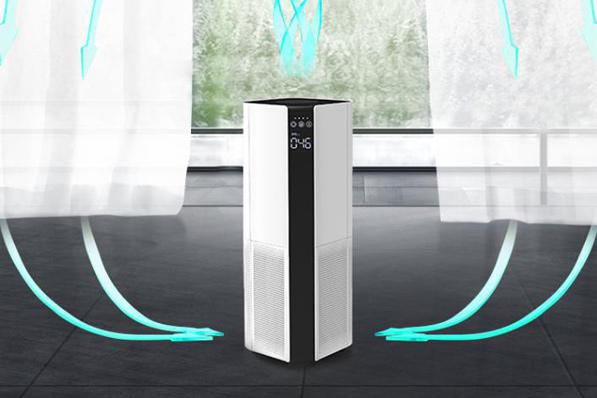
Have you noticed that most of the built-in haze meters in the air purifiers you buy don't display specific numerical values, but instead use different colored lights to represent air quality?
Why is this? The Luftmy editor boldly guesses that on one hand, manufacturers might be a bit unconfident, worrying that once users have specific values, they can judge whether the air purifier they bought actually works. On the other hand, most of them use infrared haze meters. This measurement method itself is inaccurate, so they simply choose not to display the values.
Equipping an air purifier with an external haze meter makes it easier to verify if the air purifier is truly effective.
1. How is PM2.5 measured?
Friends who have used haze meters will find that our detector readings differ from the data released by the Environmental Protection Bureau. This is because the measurement methods are different. The Environmental Protection Bureau uses direct weighing, weighing the particles collected over an hour and then taking the average. They generally announce the average for the previous hour 20 minutes after the hour mark.
The detectors in our hands use the light scattering counting method. When light shines on suspended particulate matter, it produces scattered light. The intensity of the scattered light is proportional to the concentration of the particles. By measuring the intensity of the scattered light and using an existing conversion model, the particle number concentration is obtained. Manufacturers then use their own algorithms to convert the particle number concentration into mass concentration. Since different manufacturers use different algorithms, different haze meters in the same room will show different values.
2. How to choose a haze meter?
The light scattering method is divided into two types: laser and infrared. The accuracy of laser haze meters is higher than that of infrared ones. This is because infrared haze meters use infrared sensors, while laser haze meters use laser sensors. Infrared sensors themselves have low precision and require engineers to repeatedly measure, compare, and calibrate to fit a curve, yet they remain inaccurate in the end. Laser sensors have high precision, do not require repeated calibration, and have a longer lifespan than infrared sensors, reaching up to tens of thousands of hours.
In terms of price, infrared haze meters are cheaper, often under 100 RMB. If you buy modular products on Taobao, the price is even lower. Laser haze meters cost at least 200 RMB because a single laser sensor costs around 100 RMB; adding peripheral circuits and molds brings the minimum cost to at least 150 RMB.
Therefore, most of the haze measurement modules that come with low-to-mid-range air purifiers are inaccurate infrared haze meters.
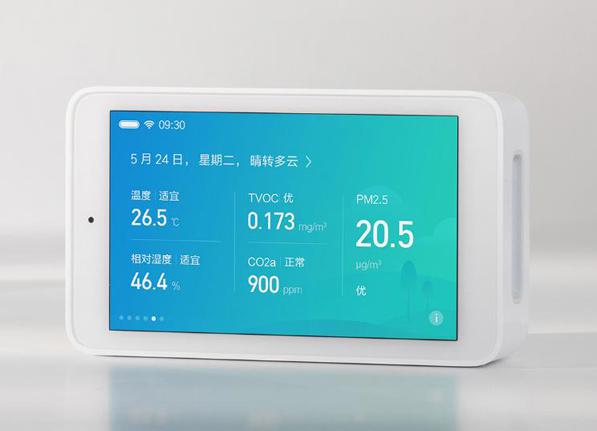
3. Are haze meter values trustworthy?
Compared to professional measurement equipment, the accuracy of these haze meters used in our daily lives is slightly lower. However, this does not mean they are unusable. Instead, when using a haze meter to monitor indoor air quality, you should look at relative numbers rather than absolute ones. For example, if the number on the haze meter drops after the purifier has been on for a while, it indicates that the air quality has improved, even if the PM2.5 concentration figure displayed isn't perfectly precise.
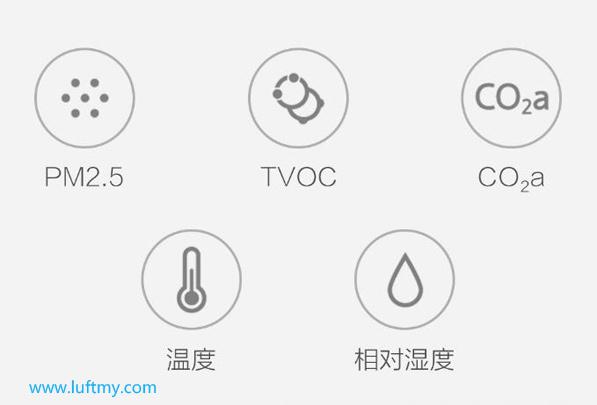
Having a haze meter in the room can both supervise the air purifier and provide peace of mind—isn't that the best of both worlds? The Luftmy editor is personally using a PM2.5 air quality detector.
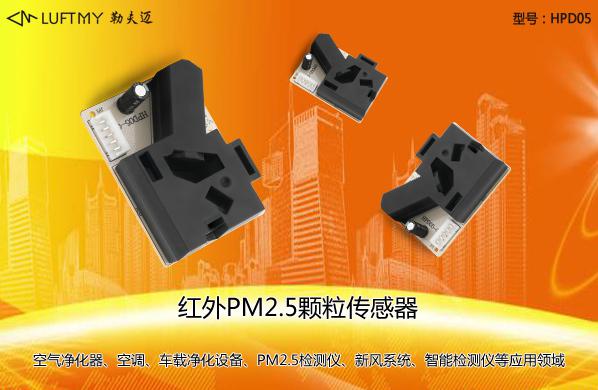
Luftmy, a digital particulate matter sensor manufacturer, offers the PM2.5 particle sensor HPD05, which uses optical scattering principles to obtain particulate concentration. Through light path and circuit conversion, it measures the dust concentration within the detection range. The Luftmy PM2.5 particle sensor HPD05 features a small size, high precision, low power consumption, short response time, and stable operation under high dust concentrations. This PM2.5 particle sensor can be applied to air purifiers, haze meters, and more.
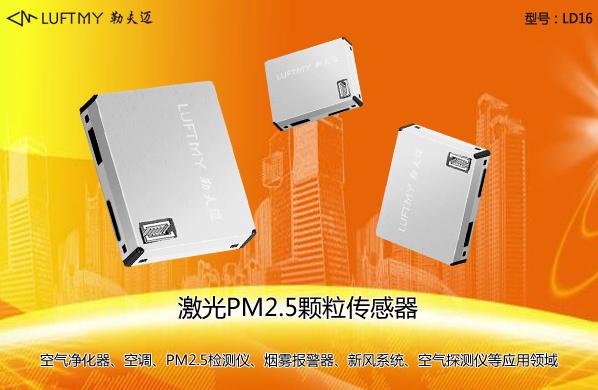
The Luftmy silent laser dust PM2.5 sensor LD16 is a high-precision particulate concentration sensor based on Mie scattering theory. It can continuously collect and calculate particulate concentration distribution and output it via a universal digital interface. The LD16 laser particulate concentration sensor features small size, high precision, strong anti-interference ability, low power consumption, long lifespan, zero false alarm rate, and short response time. The Luftmy silent laser dust PM2.5 sensor LD16 can be embedded in various instruments related to suspended particulate matter concentration, such as air purifiers, PM2.5 detectors, haze meters, or environment improvement equipment to provide timely and accurate concentration data.
Luftmy focuses on research, production, and sales of optical particulate matter sensor technology. Luftmy sensors have received wide acclaim within the industry for performance indicators such as measurement accuracy, stability, consistency error, and anti-interference.
