

Technical Support:
158-7527-1139

Air quality monitoring is injecting vitality into the sensor market! Air quality monitoring in cars, homes, and other buildings is driving the development of the gas and particulate matter sensor markets. A 2014 report by the World Health Organization (WHO) shows that outdoor air pollution is one of the major challenges of the 21st century, causing approximately 4 million deaths globally.

Another report indicates that since 2016, over 90% of the world's population lives in areas where air pollution levels exceed WHO limits. Consequently, these factors have created a global driver for the development and installation of gas and particulate matter sensors. According to Yole Développement, the primary gas and particulate matter sensor market has long been limited to industrial applications. However, today, declining air quality affects numerous sectors, including homes, offices, hotels, cars, and urban areas. Thus, air quality control has become a selling point for promoting hotels or restaurants. Historically, gas sensors in buildings were used to control air conditioning systems for energy saving and emission reduction.
Now, we observe that as residents demand clean indoor air, the primary function of gas sensors has shifted from “comfort” to “safety.” This trend extends to other environments, such as private cars and public transport, driving the growth of the gas sensor application market. For instance, the air purifier market, which often integrates gas and particulate matter sensors, is expected to grow from $16 billion in 2017 to $33 billion in 2023, with a CAGR of 12.5%. Commercial vehicles are increasingly installing gas and particulate matter sensors to ensure high-quality air for passengers. Previously, sensors would activate air conditioning when high levels of CO2 or VOCs were detected inside the vehicle.
Now, a new scenario involves external sensors notifying the system to close ventilation when ambient pollution is detected. In these cases, Metal Oxide Semiconductor (MOS) is the preferred technology due to its low cost, small size, and fast response compared to previous generations. To meet growing demand, gas sensor players like Paragon and Amphenol (which acquired SGX Sensortech) are developing particulate matter sensors; large sensor leaders like Bosch and ams have also identified air quality monitoring as a promising market. Consequently, they are leveraging their expertise to develop new technologies and solutions for gas and particle sensing.
While the gas and particulate matter sensor market has a bright future, the consumer market is taking longer than expected to grow, affecting corporate decisions. For example, ams emphasized that it would no longer expend significant effort on consumer applications in the short term. It seems the long-awaited integration of gas sensors in smartphones remains distant.
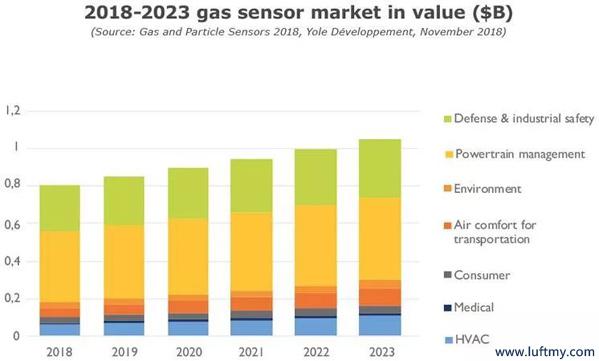
This report analyzes the global impact of air quality monitoring on each market segment. The main affected areas are HVAC, consumer products, and transportation comfort. Each segment details technical requirements, target gases, market forecasts, key suppliers, and regulations. Yole predicts the gas sensor market will reach $1 billion by 2022. Additionally, a chapter discusses environmental combo-sensors and electronic nose technology. Though challenges remain, these are the next steps for air quality sensing. MOS has finally found its market, and optical technology is used for particle sensing. MOS has existed for years, but cross-sensitivity and drift issues hindered wide adoption. Now, driven by car cabin monitoring and air purifiers, MOS technology is gaining traction as the best cost/size trade-off for VOC sensing.
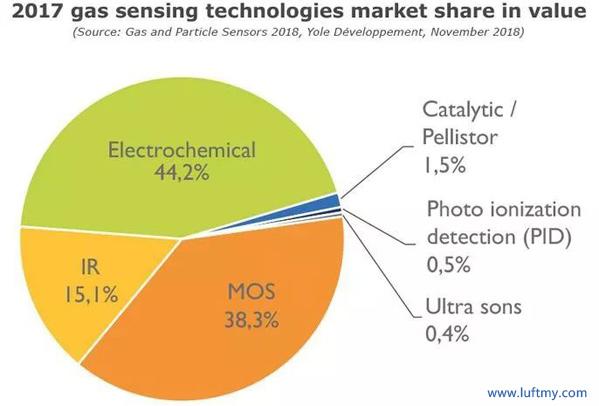
MOS is the reference technology for automotive air quality monitoring, specifically for gases. In consumer applications, miniaturized Non-Dispersive Infrared (NDIR) sensors compete with MOS. NDIR sensors are more expensive, but their size is now approaching MOS with better sensitivity. Sensor choice depends on application needs. Note: NDIR sensors are often used to detect gases and measure carbon oxide concentrations. Infrared light passes through a sampling chamber where gas components absorb specific frequencies. By measuring absorption, concentrations are determined. It is called “non-dispersive” because the light isn't pre-filtered; instead, a filter sits before the detector.
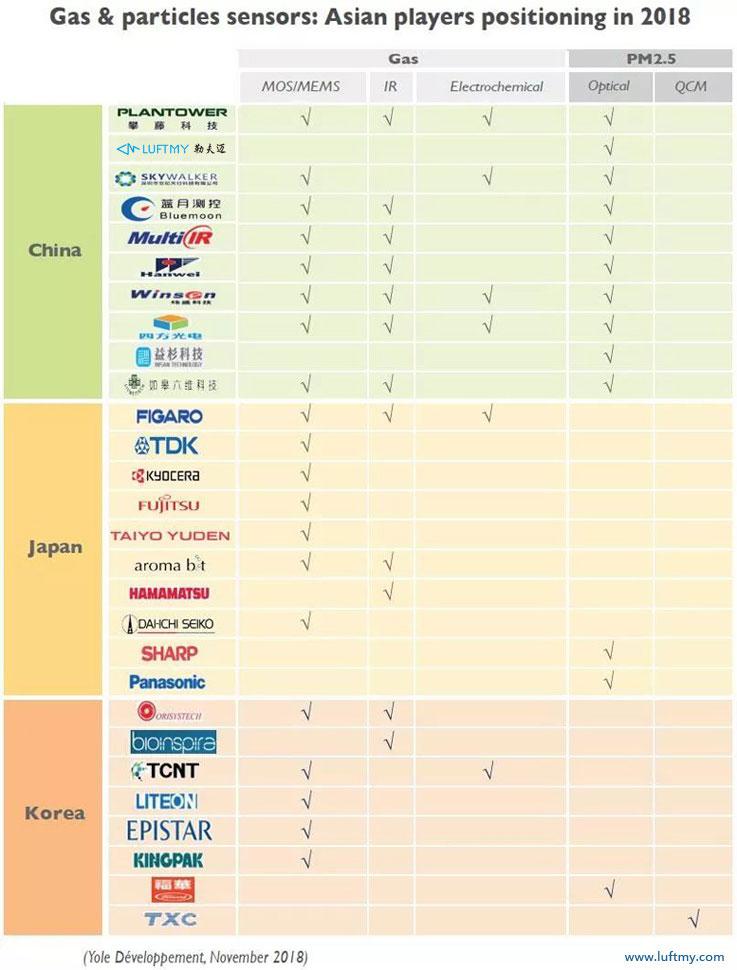
Conversely, optics is the reference technology for particle sensing. Particle monitoring is becoming more critical than gas sensing. Ultrafine particles (PM1) smaller than 1 micron are gaining attention as they are the most hazardous to health. Most manufacturers are developing particulate matter sensors for PM1 and below. The particulate matter sensor market was $150 million in 2017 and is expected to exceed $200 million by 2023. This market is less fragmented, with four players holding over 90% share, limiting space for new entrants. The Asian ecosystem is developing rapidly due to high air quality concerns. Air purifier shipments are expected to hit 20 million units annually by 2020, with China accounting for over 95%. Most integrate both VOC and particulate matter sensors. Asian manufacturers are developing local portfolios covering various technologies; for example, Japan/Taiwan focus on MOS/NDIR, while China covers almost all technologies.
Intellectual Property (IP) dynamics reflect strong interest in particulate matter sensors. Since 2010, Chinese patent applications have surged, while activities elsewhere remained stable. Since 2014, more Chinese firms and labs have joined the patent landscape.
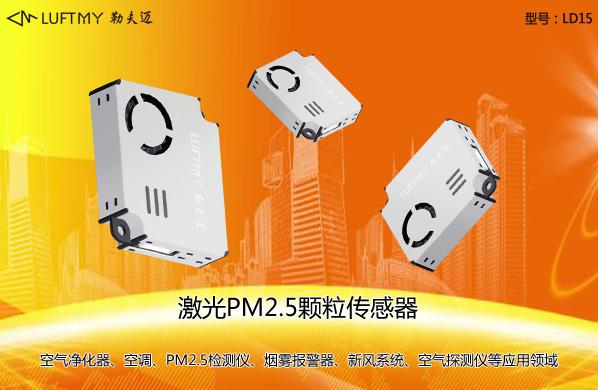
The Luftmy laser dust particle sensor LD15 is a high-precision concentration sensor based on Laser Mie scattering theory. It continuously collects and calculates particle distribution, outputting via a digital interface. The digital laser dust sensor LD15 features small size, high accuracy, strong anti-interference, low power, long life, and short response time. As a sensor manufacturer, Luftmy's LD15 can be embedded in air purifiers, PM2.5 detectors, and haze meters to provide accurate data. Check online for more air quality sensor prices.
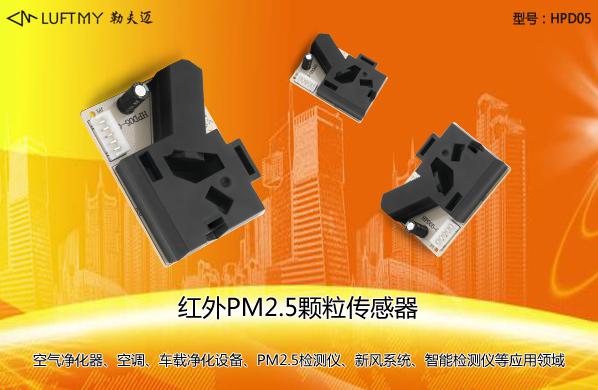
Air particulate matter sensor manufacturer Luftmy's PM2.5 particle sensor HPD05 uses optical scattering to obtain concentration by converting light paths and circuits. As a PM2.5 particle sensor manufacturer, Luftmy's HPD05 features high precision, low power, and stable operation in high dust environments. This sensor is applicable in air purifiers, haze meters, etc.
Luftmy focuses on optical particulate matter sensor research, production, and sales, receiving wide acclaim for accuracy, stability, and anti-interference performance.
