Technical Support:
158-7527-1139

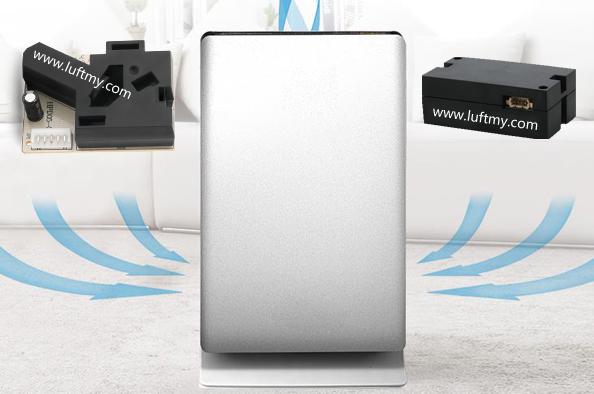
Recently, I wanted to buy an air purifier and researched some smart air purifiers currently on the market. Besides parameters, there is quite a bit of controversy regarding the dust sensors in the intelligent detection section. Feeling that both have their own advantages and are hard to choose between, the Luftmy editor consulted industry experts about the differences between pm2.5 infrared dust sensors and laser PM2.5 sensors—two types of dust concentration sensor modules. How can we identify their differences?
PM2.5 sensors, also known as dust sensors or ash sensors, can be used to detect the dust concentration in the air around us, which is the PM2.5 value. In aerodynamics, dust with a diameter of less than 10μm that can enter the alveolar region is usually referred to as respirable dust. Most dust particles with a diameter above 10μm are deposited through impact; when inhaled by humans, most are deposited in the nasopharynx, while dust below 10μm can enter the deeper parts of the respiratory tract. Most of the dust deposited in the alveoli is below 5μm.
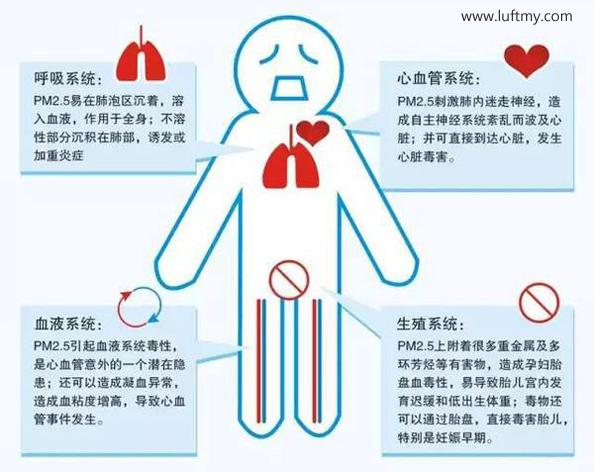
PM2.5 fine particulate matter has a small diameter, stays suspended in the atmosphere for a long time, travels long distances, and usually contains a large amount of toxic and harmful substances, thus having a greater impact on human health. PM2.5 can enter the lungs and bloodstream. Luftmy editors have learned that if it carries bacteria, it can cause great harm to the human body, including our respiratory system, cardiovascular system, and even reproductive system.
The working principle of the laser dust PM2.5 sensor module is developed based on the principle of light scattering. Particles and molecules will produce light scattering when illuminated by light, and at the same time, they absorb part of the energy of the incident light. When a beam of parallel monochromatic light is incident on the measured particle field, it will be affected by scattering and absorption around the particles, and the light intensity will be attenuated. In this way, the relative attenuation rate of the incident light passing through the concentration field to be measured can be obtained. The magnitude of the relative attenuation rate basically linearly reflects the relative concentration of dust in the field to be measured. The magnitude of the light intensity is proportional to the strength of the photoelectric-converted electrical signal. By measuring the electrical signal, the relative attenuation rate can be obtained, and thus the concentration of dust in the field to be measured can be determined.
The PM2.5 infrared dust sensor is designed to sense dust particles in the air. Inside, an infrared light-emitting diode and a phototransistor are placed diagonally, and their optical axes intersect. When an air stream carrying dust passes through the intersection area of the optical axes, the dust reflects the infrared light, and the reflected light intensity is proportional to the dust concentration.
The phototransistor enables it to detect the light reflected by dust in the air; even very small particles like tobacco smoke can be detected. The infrared LED emits light that meets the dust and produces reflected light. The receiving sensor detects the intensity of the reflected light and outputs a signal. The concentration of dust is determined according to the intensity of the output signal. By outputting two different pulse width modulation (PWM) signals, the concentration of different dust particles is distinguished.