Technical Support:
158-7527-1139


With the increasing focus on haze in recent years, more and more fresh air purification products have entered thousands of households. Although these products vary, the LUFTMY editor has noticed that their principles are roughly the same. Most of them filter out particulate matter in the air through filters, with main indicators being dust, PM2.5, etc. By incorporating detection sensors into fresh air purification products (dust detection sensors at the front end of the filter), the air condition can be detected in real-time. The detection data then controls the operation of the fresh air machine. This not only allows users to intuitively see the air quality but also scientifically and reasonably controls the operation of the equipment, achieving more efficient and energy-saving air purification performance.
Today, we introduce the application of LUFTMY's PM2.5 dust concentration detection sensor HPD05 in mid-to-low-end intelligent fresh air ventilators. This intelligent ventilator mainly consists of two dust detection sensors, a temperature and humidity sensor, PTC heating components, a main control chip, power management, a WiFi module, an axial fan, and filters.
The intelligent fresh air ventilator is primarily used for indoor air purification. It detects the particulate matter content in the air through two dust sensors installed at the front and back ends of the filter. The main control chip controls the axial fan based on the sensor data, allowing the air to pass through the filter to achieve purification. It also judges the filter's efficiency and remaining service life based on the data from the two sensors. Simultaneously, the ventilator can upload key parameters such as sensor data, fan status, and PTC heater status to a cloud server via WiFi. Users can operate the ventilator through their smartphones, further enhancing the user experience.
In this ventilator, the dust sensor is the key component for intelligent operation, primarily used to detect dust content parameters in indoor air. Therefore, the performance parameters of this sensor determine the accuracy of the detected air quality and whether the ventilator can operate efficiently. Since this product is positioned for the mid-to-low-end market, the cost of various components must be a priority during selection. Considering both points, this ventilator uses the LUFTMY PM2.5 dust detection sensor HPD05.
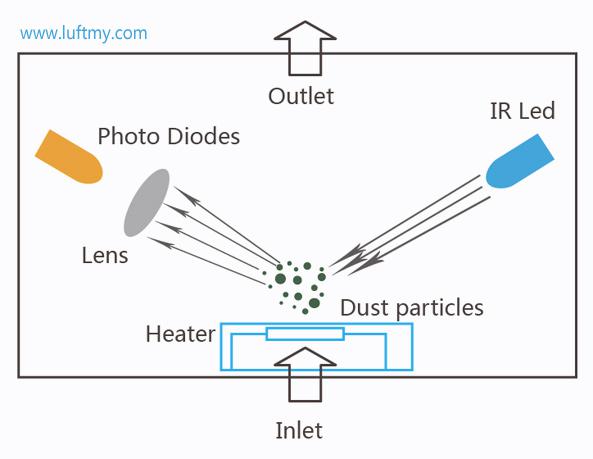
The PM2.5 dust sensor manufacturer LUFTMY's PM2.5 dust concentration detection sensor HPD05 is an optical sensor for detecting dust concentration in the air. Its ability to detect ultra-fine particles has been significantly improved, capable of detecting particles from 0.5 to 10 microns. This makes it more accurate than traditional sensors in estimating PM2.5/PM10 mass concentration values. Its internal principle block diagram is shown below: inside the sensor, there is an infrared LED and a light-receiving sensor with intersecting optical axes. When a dusty airflow passes through the intersection area, the dust reflects the infrared light, and the reflected light intensity is proportional to the dust concentration. The light sensor detects the reflected light, and after signal conditioning, outputs the concentration via PWM or UART. This method is simple, reliable, and relatively low-cost, making it very suitable for this intelligent fresh air ventilator.