

Technical Support:
158-7527-1139

A gas sensor is a converter that transforms the volume fraction of a certain gas into a corresponding electrical signal. The probe conditions the gas sample through the gas sensor, which typically includes filtering out impurities and interfering gases, and drying or cooling the instrument display section. Gas sensors are applied in various fields; let us take a look at them.

Sensors for Analytical Instruments:
These types of gas sensors are mainly used in instruments for environmental monitoring stations, environmental protection testing or metrology calibration agencies, and scientific research institutes. They are characterized by high precision, large volume, and high price, with foreign brands occupying the mainstream market in this field.
Environmental Monitoring Sensors for Industrial Use:
This includes indoor and outdoor environmental monitoring at work sites. Indoors, monitoring involves organic vapors, combustible gases, and other flammable, explosive, or toxic gases depending on the environment; outdoors, it primarily monitors VOC emission concentrations, specifically various pollutants such as ammonia, benzene, and toluene. Currently, domestic and imported gas sensors each account for half of the market share in this field.
Environmental Monitoring Sensors for Civil Use:
These are mainly used in indoor and outdoor residential homes or common commercial places such as shopping malls, stations, airports, schools, and roads. With the emphasis on respiratory health in recent years, this field has developed rapidly.
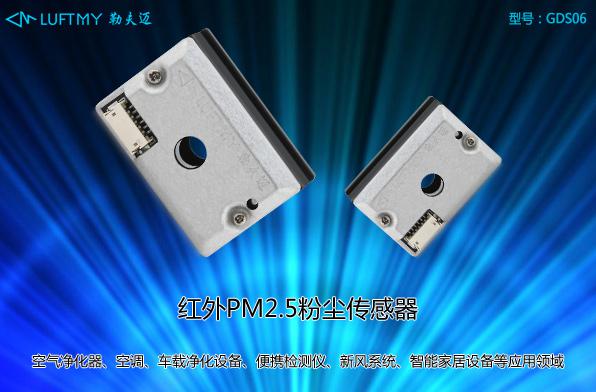
At present, the main demand in the civil field is to achieve particle measurement, primarily for pollutants like PM2.5, as well as monitoring natural gas and coal gas. Monitoring for formaldehyde and indoor organic gaseous substances (TVOC) has not yet been widely applied. The PM2.5 sensors currently developed and produced by Luftmy are mainly infrared and laser sensors. Infrared particulate sensors have anti-dust accumulation and anti-interference capabilities with high cost-effectiveness, serving as low-cost alternatives to laser sensors. Laser PM2.5 sensors offer high precision, detecting particle sizes ranging from 0.1 to 10μm. Both can be embedded in relevant instruments to provide timely and accurate concentration data. For detailed product specifications, please contact customer service.
