

Technical Support:
158-7527-1139

Known as the “World's Factory,” China has experienced rapid economic development since the reform and opening up. A large number of people have entered business, and many capable and qualified individuals have established factories of various sizes. However, environmental pollution issues followed. The 'three wastes' in industrial pollution not only destroy the ecological environment but also directly threaten human health. Consequently, relevant departments place great importance on environmental monitoring. Air quality sensor modules can be applied to environmental monitoring.
Due to previous economic models, an emphasis on economic development combined with a neglect of environmental protection led to continuous environmental deterioration. As environmental monitoring work was just beginning, the systems were incomplete, and many cities failed to meet monitoring standards. Moreover, human and material resources, funding, and equipment fell short in many aspects, and there was no certainty regarding large-scale environmental monitoring, leaving environmental monitoring work in a backward state.

In environmental monitoring work, unexpected situations often occur. However, if measures are not taken promptly to resolve them, our environmental monitoring cannot be done well. Additionally, the costs of environmental monitoring and analysis are relatively high. Furthermore, many regions lack complete testing equipment, meaning emergency equipment cannot operate in time and fails to play a proactive role.
Today, air quality sensor modules utilize the latest sensing technologies to effectively reduce monitoring costs. Through the large-scale deployment of monitoring points, high-density monitoring of regional environments is achieved, forming a grid monitoring system. This has opened channels between online monitoring and government supervision, providing decision support for scientific haze control and precise pollution control, which greatly benefits real-time monitoring and scientific environmental management. Urban environment grid monitoring systems can monitor various atmospheric parameters, providing 24-hour continuous online monitoring of PM2.5, PM10, SO2, NO2, CO, O3, etc., supplying air quality data at any time. The prediction accuracy for pollution processes reaches 100%, and the average prediction accuracy for pollution degrees is close to 80%.
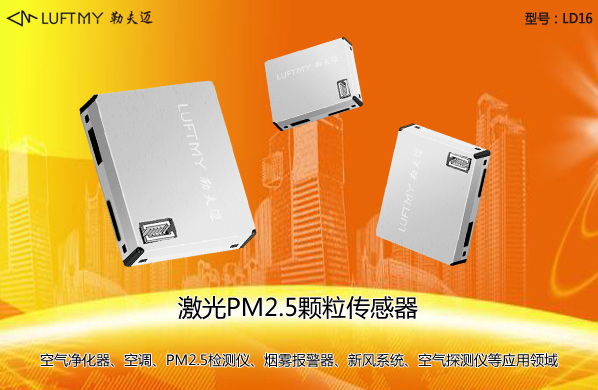
Luftmy's LD16 laser sensor adopts the Mie spherical particle scattering principle. That is, the laser sensor uses a laser to illuminate suspended particulate matter in the air to produce light scattering. The photodetector collects the scattered light intensity within a certain angular range, converts the obtained light intensity linearly into voltage, and then sends it to a data processing system. The data processing system processes the data according to a pre-programmed procedure based on Mie scattering theory, yielding the equivalent particle size of the particles and the number of particles of different sizes per unit volume. It can be applied to environmental monitoring.
