Technical Support:
158-7527-1139

When an air purifier is working, it displays the monitored air quality through lights or specific numerical values. This function is realized by a PM2.5 sensor. Common PM2.5 sensors are divided into infrared PM2.5 sensors and laser PM2.5 sensors. Should you choose infrared or laser for the PM2.5 sensor in an air purifier?
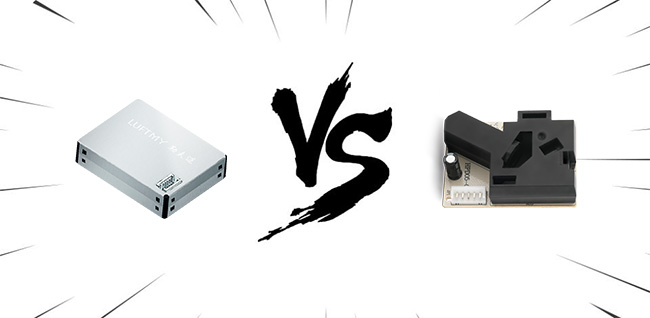
The working principles of infrared PM2.5 sensors and laser PM2.5 sensors are similar, both utilizing optical reflection and refraction principles. The main differences lie in the structure (the light emitting head, receiving head, and airflow drive method) and the resulting accuracy. The internal structure and circuit design of infrared PM2.5 sensors are relatively simple; they use infrared light-emitting diodes as the light source. The airflow inlet and outlet mainly rely on a heating resistor to drive the flow of surrounding gases via thermal air. They use phototransistors to receive reflected light and output a PWM signal. This signal cannot be displayed intuitively and requires further calculation to derive the particulate concentration range.
Due to the characteristics of infrared light and its simple internal structural design, infrared PM2.5 sensors have the following features: low cost, simple implementation of principle, relatively accurate detection of large-diameter particles, but insensitive to smaller particulate matter.
In contrast, laser PM2.5 sensors have a more complex internal structure and circuit design. The light source uses a more stable laser diode, and a fixed fan is installed internally to drive airflow. When particulate matter in the air enters the area where the laser beam is located, the light detector receives scattered light, generating a current signal through the photoelectric effect. After circuit amplification and processing, the fine particulate concentration value can be obtained, with the output signal generally being a serial port output.
Therefore, laser sensors have the following features: higher application cost and more complex working methods, but high reliability of detected data and relatively accurate detection of both large and small particles. Furthermore, their response to external air quality is more sensitive and faster than that of infrared PM2.5 sensors!
Both types of sensors are currently mainstream. however, because laser sensors have advantages in data accuracy and response speed, they are more popular in the mid-to-high-end market. In fact, ensuring data accuracy requires more than just structural efforts. Whether it is a simpler infrared PM2.5 sensor or a more complex laser PM2.5 sensor, measurement accuracy depends heavily on the calibration and normalization of the sensor, which is a crucial part of designing, manufacturing, and using sensors. Calibration refers to the process of establishing the relationship between sensor output and input through testing and determining errors under different conditions. The goal is to determine various performance indicators of the sensor based on experimental data and make corrections as needed to ensure measurement accuracy. This is a relatively complex process, and the calibration results are easily affected by calibration conditions and methods. In other words, a high-precision sensor may produce large errors in actual measurement if the calibration method is improper, while a sensor with lower inherent precision might produce smaller errors if the calibration method is appropriate. Luftmy sensors utilize a world-leading full-range calibration system, calibrating over 1700 points, far leading the industry standard of 2 points, which greatly improves measurement accuracy and product consistency.