Technical Support:
158-7527-1139

The term photoelectric sensor may sound unfamiliar, but with the rapid development of technology today, smart devices can be seen everywhere in our lives. The components of these devices are inseparable from sensors, and photoelectric sensors are among the most widely used types of sensors. Examples include barcode scanning during supermarket checkout, monitoring air PM2.5 data, and smoke alarms in public places. After the outbreak of the novel coronavirus, forehead thermometers used for rapid body temperature detection also utilized photoelectric sensors. So, what is the working principle and characteristics of the photoelectric sensor?
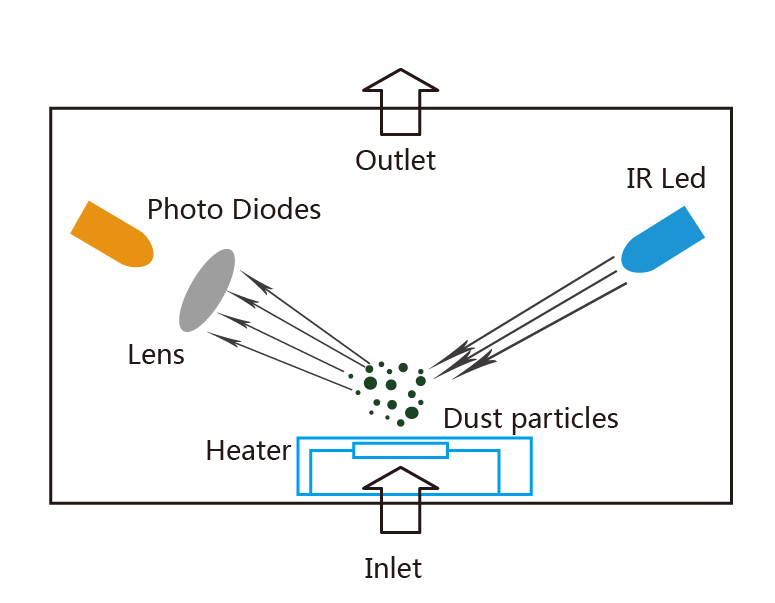
Working principle of the photoelectric sensor:
Photoelectric sensors achieve control by converting changes in light intensity into changes in electrical signals.
In general, a photoelectric sensor consists of three parts: the transmitter, the receiver, and the detection circuit.
The transmitter aims at the target and emits a light beam, which generally comes from semiconductor light sources such as light-emitting diodes (LEDs), laser diodes, and infrared emitting diodes. The beam is emitted continuously or by changing the pulse width. The receiver consists of photodiodes, phototransistors, or photocells. In front of the receiver, optical components such as lenses and apertures are installed. Behind it is the detection circuit, which can filter out effective signals and apply them.
In addition, the structural components of photoelectric switches include reflective plates and optical fibers.
The corner-cube retroreflector is a structurally robust reflecting device. It consists of small triangular pyramid reflective materials that allow the light beam to return accurately from the reflector, which has practical significance. It can change the emission angle within the range of 0 to 25 degrees relative to the optical axis, making the light beam almost return along the same line after reflection.
Characteristics of photoelectric sensors:
① Non-contact detection: The sensor has a long service life and causes no damage to the detected object.
② Suitable for long-distance detection with wide applications.
③ Applicable to a wide variety of detected objects, as long as the object affects light propagation.
④ High response frequency, suitable for use in high-speed assembly line detection.
⑤ High detection accuracy, can be used for different color discrimination.
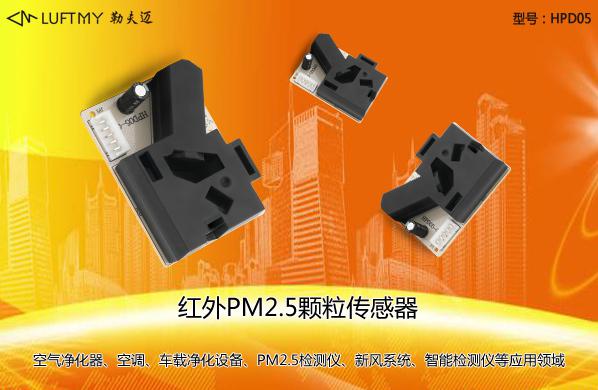
The HPD05 infrared PM2.5 sensor module uses the principle of optical scattering to detect the concentration of dust in the air. The sensor has a built-in infrared light-emitting diode and a high-sensitivity photoelectric receiving sensor. The light emitted by the infrared LED produces reflected light when it encounters dust. The photoelectric sensor reflects the dust concentration in the air by detecting the intensity of this reflected light. The sensor directly outputs a PWM signal, where the PWM width is the current concentration value (1ms = 1ug/m3). Dust concentration values can also be output through IIC serial signals in units of ug/m3. This sensor is suitable for air purifiers, air conditioners with purification functions, fresh air systems, and air quality detection instruments.
LUFTMY's current products include GDS06 infrared PM2.5 sensors, HPD05 infrared PM2.5 sensors, micro-dust sensors, and laser sensors. Through continuous R&D and manufacturing of the latest processes, these products have the advantages of high sensitivity, consistency, and stability, earning significant recognition and praise from customers in the industry. For more product information and sample requests, please contact customer service.