

Technical Support:
158-7527-1139


Living standards are constantly improving, and there have been significant enhancements in all aspects of life, including clothing, food, housing, and transportation. In terms of transportation, the number of cars is gradually increasing. Nowadays, almost every family owns its own car, which seems to have become another symbol of status; some even purchase very luxurious high-end vehicles.
Regardless of the type of car, if driven for a long time without proper preventive measures, many problems will naturally arise. First and foremost, the air inside the car can smell very unpleasant; as soon as a person sits inside, they may notice an odor. Additionally, due to severe external environmental pollution, the PM2.5 concentration inside the car can seriously exceed standards. This not only significantly impacts the driving experience but also affects human health over time.
To cater to the market, major automobile manufacturers have successively added air purification systems or equipped on-board purifiers to cars to improve indoor air quality and enhance user comfort. The purification system mainly consists of two processes: detection and purification. The detection process is generally carried out by equipping odor sensors and PM2.5 sensors to monitor the air quality inside the car. The purification process generally includes methods such as internal circulation ventilation, filter filtration, and negative ions.
To this end, the editor of LUFTMY has focused on introducing sensor solution scenarios and related knowledge for automotive purification systems based on various information and data. Air pollution in cars mainly consists of odor and PM2.5 pollution.
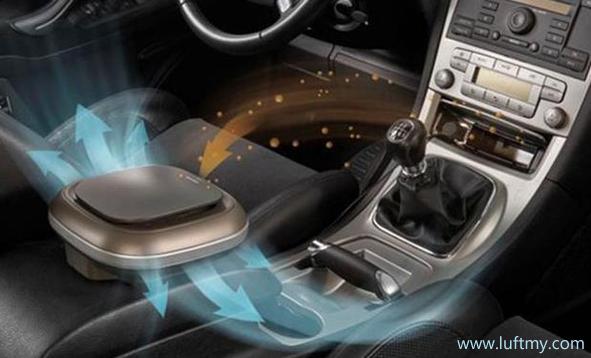
I. Sources of Car Odor Pollution
Musty smell: This may be caused by bacteria produced in the evaporator and air ducts because the car's air conditioning system has not been cleaned for a long time; the odor comes from bacterial mold.
Gasoline smell: Aging of the rubber piping of the gasoline purification carbon canister; leakage at the gasoline pipe interface, which needs tightening/repair; or poor sealing performance after disassembling and assembling the gasoline pump. Filling the gas tank too full can also cause a strong gasoline smell inside the car.
When opening the door of a new car, a strong smell of plastic and rubber can be noticed. Sitting in the car for a long time may even cause passengers to experience vomiting or fainting. This mainly comes from the interior trim, including the dashboard, doors, seats, and a series of plastic and leather-covered parts. Plastic parts produced just a few months ago have a faint smell, determined by the stability of their chemical properties.
Furthermore, for covered parts, glue is used to bond the plastic skeleton and leather. The glue itself contains a series of irritating odors such as benzene compounds and hyaluronic acid, which are quite consistent with the odor of a new car. After exposure to the sun, these items emit harmful substances such as formaldehyde and benzene, affecting human health.
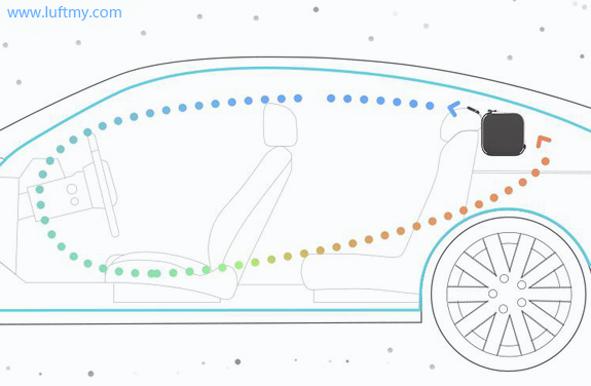
II. PM2.5 Detection in Cars and Commonly Used Sensors
Most odors can be smelled, but particulate matter pollution in the air is invisible and intangible. Purification systems are generally equipped with PM2.5 sensors to better detect toxic and harmful substances in the air. Here, the LUFTMY editor recommends the LD11 laser PM2.5 sensor for detecting PM2.5 from the dust sensor manufacturer Guangzhou LUFTMY. The automotive particulate matter sensor module LD11 is a high-precision particulate matter concentration sensor based on Laser Mie Scattering theory. It can continuously collect and calculate the number of suspended particles of different sizes in the air per unit volume—namely, the particle concentration distribution—and then convert it into mass concentration, outputting it via a universal digital interface. This automotive air quality sensor product is a universal, miniaturized module. Using the Mie scattering principle to detect dust particles in the air, it has good consistency and stability. It features serial port output and PWM output for ease of use. Its small size makes it easy to integrate. It is used to detect PM1.0, PM2.5, and PM10.
1. Main Features of the Air Pollution Sensor LD11
Thin and light design, zero false alarm rate, high consistency, real-time response, high measurement accuracy, low power consumption, long lifespan, and multi-protocol serial output for PM0.3\PM0.5\PM1.0\PM2.5\PM10.
2. Main Applications of the Automotive Particulate Matter Sensor LD11
Air purifiers, fresh air systems, portable instruments, air quality monitoring equipment, air conditioners, smart home devices, and other locations.
Equipping automotive air purification systems with air quality PM2.5 sensors will be a major trend in future automotive development. Once poor air quality or high PM2.5 concentration is detected inside the car, the on-board purification system will automatically start to purify the air, keeping the car interior fresh at all times.
