

Technical Support:
158-7527-1139

Air quality issues have received widespread attention in daily life. For instance, the once-heated topic of in-car air quality: Is there an odor inside the vehicle? Is there air pollution? How are in-car air quality standards judged? How can the demand for a comfortable driving environment for car owners be met? These questions need to be addressed from multiple aspects, including systems, standards, supervision, and the industry chain. Some experts have also called for the rapid implementation of mandatory standards for in-car pollution. Of course, the Luftmy editor feels this requires a process, and before that, a new trend has quietly emerged in the auto market——equipping vehicles with PM2.5 sensors.
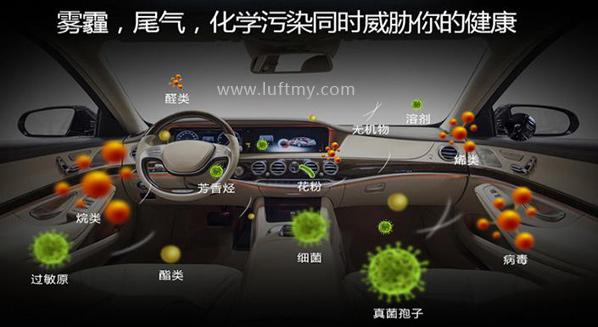
That's right, the battle for customers in the auto market has added a new bargaining chip. While smooth lines, beautiful models, comfort, safety, and fuel/electricity efficiency are common topics, new highlights like the Internet of Vehicles, smart features, and on-board air purifiers are lining up; seizing hotspots is the trend. So let's look at the PM2.5 sensor. As the name suggests, it is a device used to detect the concentration of dust in the air. Developed based on the principle of light scattering, it reflects the relative concentration of dust in the measured field by the relative attenuation rate of incident light passing through the concentration field. Then, through electrical signal conversion, the concentration value is determined.
Clearly, equipping a PM2.5 sensor in a car, allowing drivers and passengers to stay informed of the PM2.5 concentration and make adjustments accordingly, is a reasonable choice that meets current consumer demand. Of course, PM2.5 sensors are more commonly built into air purifier products, which not only reflect concentration values but also directly filter the air to maintain high air quality. Installing car purifiers in vehicles may become the norm, and PM2.5 sensors will also become standard. Beyond this, the stage for PM2.5 sensors is not limited to the interior space; the vast exterior space cannot be ignored, or rather, the layout there started even earlier.
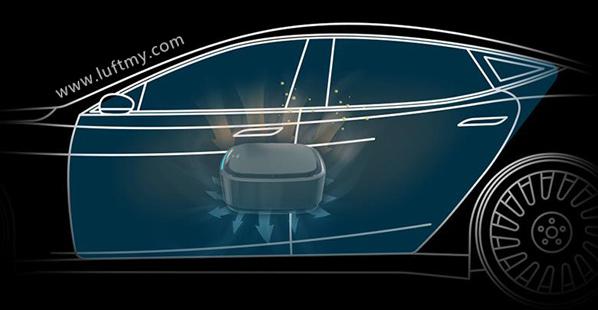
Air purifiers are entering ordinary households and are expected to become the next common household appliance as public concern over air quality rises, a fact recognized by the industry. Therefore, the role of PM2.5 sensors is self-evident. Basically, air purification products are equipped with three sensors: temperature and humidity sensors, dust sensors, and odor sensors. Extending this further, beyond indoor air purifiers, PM2.5 sensors are also commonly found in PM2.5 detectors, gas detectors, air conditioners with purification functions, range hoods, fresh air systems, smoke alarms, sweepers, vacuum cleaners, smart trash cans, sweeping robots, and other equipment.
Luftmy developed the S7-L Smart Dust particle counting sensor for real-time display of cleaning levels in vacuum cleaners and sweeping robots. It uses an infrared transmission method: when dust particles pass through the infrared light transmission area, the receiving end detects changes in the light signal corresponding to the particles. Through patented particle signal acquisition technology, it can accurately detect the number and concentration data of particles in the ventilation ducts of vacuum cleaner handles or extension poles, sweeping robots, and particle detection instruments.
According to public research, there are currently two main types of PM2.5 sensors on the market: infrared and laser. In terms of detection accuracy, laser types are superior; in terms of cost, the infrared price range is more accessible, so they are often used in civil equipment. High-end markets generally have higher data requirements, so industrial-grade PM2.5 sensors are commonly found in meteorological stations and environmental monitoring stations. Versatile use across low, medium, and high-end markets combined with urgent market demand has paved the way for the popularity of PM2.5 sensors.
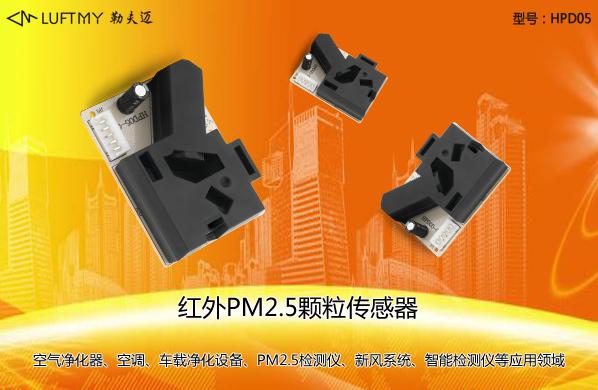
Infrared dust PM2.5 sensor manufacturer Luftmy's particle counting sensor HPD05 utilizes optical scattering principles to obtain particle concentration. By converting optical paths and circuits, it measures the dust concentration within the detection range. PM2.5 sensor supplier Luftmy's automotive air quality sensor HPD05 features a small size, high precision, low power consumption, short response time, and stable operation under high dust concentrations. This automotive air quality sensor can be applied to air purifiers and fresh air systems.
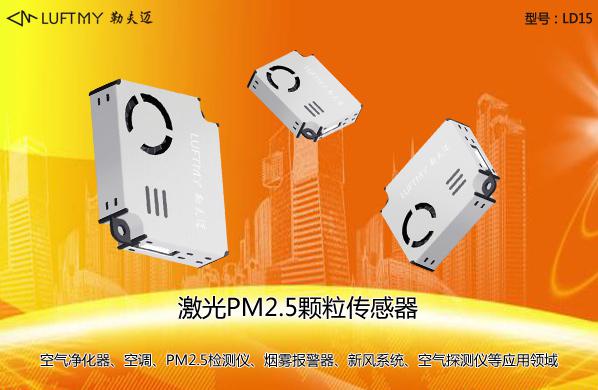
Laser dust PM2.5 sensor manufacturer Luftmy's laser scattering particle sensor LD15 is a high-precision particle concentration sensor based on Laser Mie Scattering Theory. It can continuously collect and calculate particle concentration distribution and output it via a universal digital interface. The LD15 features a small size, high precision, strong anti-interference capability, low power consumption, long life, zero false alarm rate, and short response time. PM2.5 sensor supplier Luftmy's automotive particle sensor LD15 can be embedded in various instruments or environment improvement equipment related to suspended particle concentration, such as air purifiers, PM2.5 detectors, and fresh air systems, providing timely and accurate concentration data.
Luftmy focuses on the research, production, and sales of optical particle sensor technology. Luftmy sensors have been widely praised in the industry for their measurement accuracy, stability, consistency error, anti-interference, and other performance indicators.
