Technical Support:
158-7527-1139

According to the results of the first public welfare research report on indoor PM2.5 pollution released by Tsinghua University, the impact of indoor PM2.5 pollution on people is more significant than outdoor PM2.5 pollution, with the inhalation of indoor PM2.5 being four times that of outdoors.
Why is the concentration of indoor PM2.5 greater than outdoor?
This is due to what we commonly refer to as PM10 and PM2.5. PM10 refers to the concentration of dust particles with a diameter of 10 microns, while PM2.5 refers to those with a diameter of 2.5 microns. In an indoor setting, such small particles are all suspended matter. We open windows for ventilation every day; under horizontal effects, the larger the diameter, the greater the force received in the horizontal direction, resulting in a faster movement speed compared to smaller particles. Consequently, larger particles can quickly move outdoors, while smaller diameter particles remain indoors.
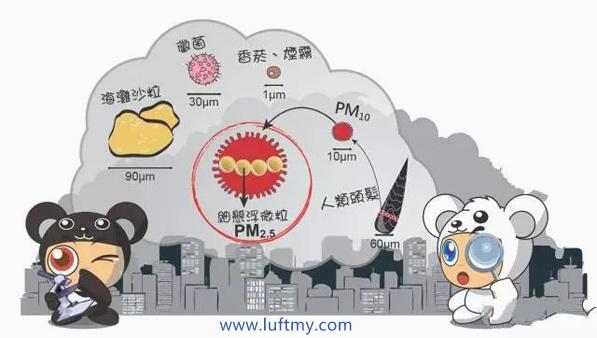
On the other hand, most metabolic particles from the human body at night are smaller than 0.3 microns and do not diffuse easily, leading to greater accumulation indoors. Over time, a situation arises where indoor PM2.5 concentration is inversely higher than outdoor. Therefore, when smog is rampant, no one can remain unaffected. The practice of living behind closed doors and ignoring what happens outside the window is merely self-deception.
What factors cause indoor PM2.5 levels to exceed standards:
1. Numerous indoor pollution sources such as air conditioning, cooking, and renovation.
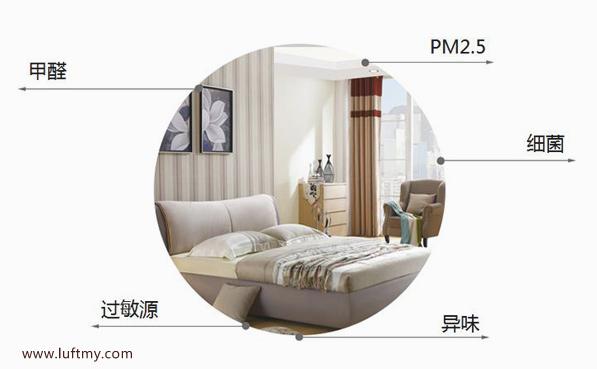
Although smoking and outdoor polluted air are two major factors for excessive indoor PM2.5, they are not the only sources. According to relevant research, air conditioning, cooking, renovation pollution, and dust accumulation are all closely linked to the deterioration of the indoor air environment. Tests by the Shanghai Center for Disease Control and Fudan University proved that pollutants such as bacteria and viruses in the accumulated dust of most household air conditioners seriously exceed standards, with the number of bacteria in the most severe cases exceeding that of shopping mall central air conditioners by more than 50 times.
2. Smoking is a primary factor leading to excessive indoor PM2.5.
Tobacco smoke includes 69 types of Class I carcinogens and 172 types of harmful substances. Besides causing lung cancer, heart disease, bronchitis, and asthma, it is a significant source of indoor air pollution. In rooms where someone is smoking, fine particles derived from secondhand smoke account for about 90% of the total indoor PM2.5. Experts have found through testing that as long as the smell of smoke can be detected in a room, the PM2.5 exceeds the standard by at least double.
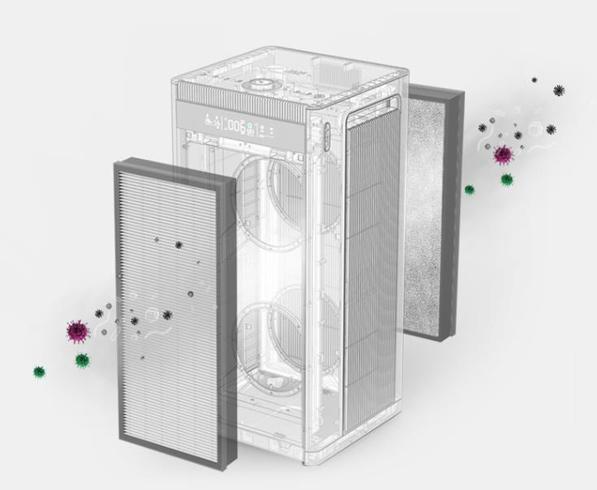
Therefore, the best way to prevent and control indoor PM2.5 is still to pay attention to the reasonable selection and correct use of air purifiers. Air purification devices are all installed with PM2.5 sensors. Negative ions in air purifiers can actively capture small particles, causing them to condense and settle, effectively removing dust of 2.5 microns (PM2.5) and below from the air.
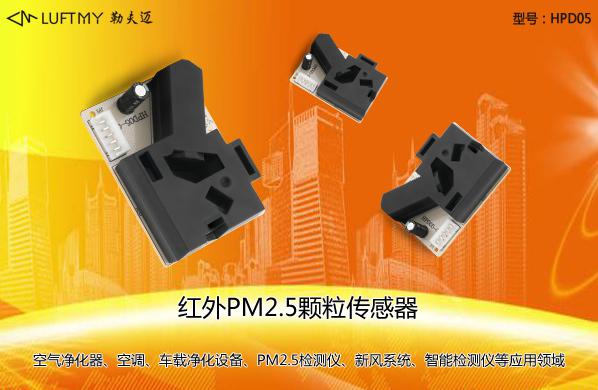
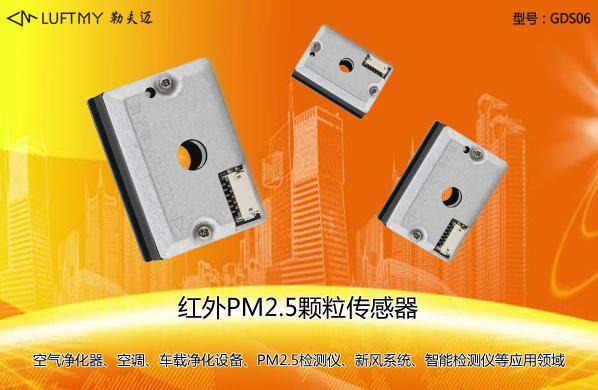
In the current field of air purification, PM2.5 sensors have almost become standard hardware for purification equipment. Their effect is to monitor the concentration of particles like PM2.5 in the air. The working principle is as follows: inside the PM2.5 sensor, there is a constant light source (such as an infrared LED). When air passes through the light, particles in it scatter the light, leading to attenuation of light intensity. The relative attenuation rate is proportional to the concentration of the particles. Given the application of PM2.5 sensors in air purification equipment, the Luftmy editor recommends the infrared PM2.5 sensor GDS06 and infrared PM2.5 sensor HPD05:
PM2.5 sensor brand Luftmy's infrared detection and counting sensor GDS06 utilizes the principle of optical scattering to obtain particle concentration. When a beam of parallel monochromatic light is incident on the measured particle field, it is affected by scattering and absorption around the particles, causing light intensity to attenuate. The relative attenuation rate of the incident light through the field can be determined. The magnitude of this rate basically reflects the relative concentration of dust in the measured field linearly. Light intensity is proportional to the strength of the photoelectric signal; by measuring the electrical signal, the relative attenuation rate can be obtained, thereby determining the dust concentration, which is then communicated via PWM or UART using a microcontroller. The smog PM2.5 sensor GDS06 detects particles of about 0.3 microns, such as indoor dust, pollen, microorganisms, dust mites, and cigarette smoke, measuring the concentration of suspended particles in spaces no larger than 10 microns. This light-scattering PM2.5 sensor is suitable for automatic air monitoring systems in rooms, such as air purifiers and fresh air systems.
Infrared detection counting sensor supplier Luftmy's PM2.5 particle concentration sensor HPD05 adopts the principle of optical scattering to detect the concentration of dust in the air. The sensor features a built-in infrared LED and a highly sensitive photoelectric receiving sensor. The infrared LED emits light that reflects upon encountering dust; the photoelectric sensor reflects the dust concentration by detecting the intensity of this reflected light. The sensor directly outputs a PWM signal, where the PWM width represents the current concentration value. It can also output dust concentration values via IIC serial signals in units of ug/m3. The PM2.5 sensor HPD05 has a dual advantage of stable detection capability and high production efficiency. Luftmy's light-scattering PM2.5 sensor HPD05 features a small size, high precision, low power consumption, and short response time, and it can operate stably under high dust concentrations. This smog PM2.5 sensor can be applied in air purifiers, fresh air systems, etc.