

Technical Support:
158-7527-1139

In recent years, with China continuously increasing its efforts in environmental protection and the construction of ecological civilization, air conditions have been effectively improved. People are beginning to pay more attention to indoor air quality.
99.8% of Respondents Value Air Quality
The survey shows that 99.8% of respondents pay attention to air quality to varying degrees, with as many as 91.9% stating they are “very concerned” or “relatively concerned.” Respondents in megacities place a higher importance on air quality. Those from Chengdu had the highest proportion of being “very concerned” at 76.8%; followed by Beijing at 74.4% and Shanghai at 72.9%. Younger generations show more concern; over 70% of respondents aged 30 and under are “very concerned,” while the proportion exceeds 60% for age groups 31-35, 36-40, and over 45. Interestingly, less than half (45.6%) of those aged 41-45 are “very concerned.”
The data indicates that women are more likely to believe indoor and outdoor air are equally important. In contrast, men focus more on outdoor air. 45.4% of men believe “outdoor air quality is more important,” which is 1.9 times the 23.6% of women who hold that view. Meanwhile, 55.9% of women believe indoor and outdoor air are “equally important,” twice the 27.6% rate of men.
“Formaldehyde” is the Largest Indoor Pollution Source
According to the survey, decoration pollutants such as formaldehyde are regarded as the primary source of indoor air pollution, accounting for 57.0%. Respondents aged 20-35 view decoration pollution and “new furniture” as main sources, while those over 36 identify “kitchen oil fumes” as the top pollutant. Men generally blame formaldehyde and furniture, while women choose “kitchen fumes,” “kitchen waste,” “dust,” and “indoor (bathroom) odors” at significantly higher rates than men.
Indoor Air Quality Satisfaction Score: 7.74
Self-assessments of indoor air quality show that 15% feel it is below standard, while nearly 30% gave a perfect score, with an average of 7.74. As household income increases, self-rated scores for indoor air quality also rise. Low-income families (under 30,000 RMB) gave the lowest average score of 7.58, while middle-class or well-off families (above 480,000 RMB) gave the highest score of 8.35.
Which Indoor Pollutants are Most Harmful?
Respondents believe the biggest impact of indoor air pollution is “respiratory diseases such as sore throat, coughing, and pharyngitis” (63.4%), followed by “skin dryness, itching, and allergies” (51.1%). Other impacts include: “dizziness, dry eyes, lethargy, and memory loss” (49.2%), “childhood leukemia” (35.8%), “fetal malformation or infertility” (25.8%), and “serious diseases like lung cancer in adults” (16.1%). Only 0.7% believe it causes no harm. Formaldehyde was identified as the most hazardous substance (68.7%), followed by benzene (toluene, xylene) at 59.7%, TVOCs (36.9%), PM2.5 (34.6%), and ammonia (31.9%).
Focus on Indoor Air Pollution and Improve Health Protection
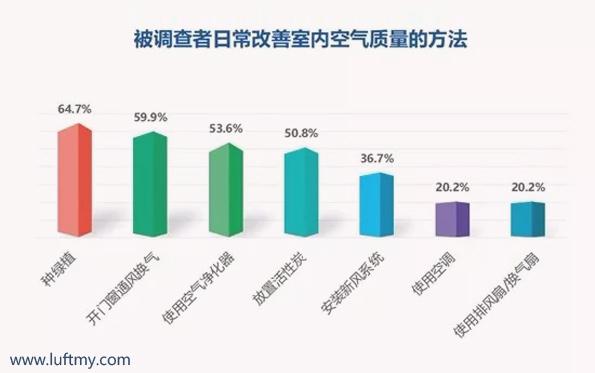
According to the survey, the level of concern for indoor air quality is much lower than for outdoor air. Judgments are still mainly based on sensory perception rather than professional science. Many rely on green plants or opening windows; however, plants are not suitable for everyone and may cause allergies in sensitive groups. Opening windows is often impractical in winter and may allow outdoor pollutants to enter and worsen the indoor environment.
Research shows that people spend an average of over 80% of their time indoors. For pregnant women, children, and the elderly, this duration is even longer. Consequently, even low concentrations of pollutants can have adverse health effects over long-term exposure.
Indoor air pollution is diverse in both pollutant types and sources, including physical (dust particles), chemical (formaldehyde), and microbial (bacteria/viruses) pollution. In relatively enclosed spaces with poor airflow, pollutants accumulate easily, reaching hazardous concentrations. Over 900 types of indoor air pollutants have been identified. They are often difficult to detect and easy to ignore. Kitchen fumes, in particular, contain carcinogenic mutagens. Since women, children, and the elderly spend more time at home, the impact on their health is particularly severe.
It is recommended to strengthen publicity regarding the hazards of indoor air pollution and its relationship with health. Consumer education should be expanded through expert-led community training. Update perceptions and improve the ability to identify and protect against indoor environmental pollution.
To address these issues, more families are using air purifiers. The working principle involves three steps: detection, purification, and release. Detecting pollutants, filtering them, and releasing clean air must work in harmony to maximize efficiency.
In the current field of air purification, air quality sensors have become a standard component, used to monitor the concentration of particles like PM2.5 in the air.
