

Technical Support:
158-7527-1139

Environmental pollution is an urgent problem in China. Due to complex sources and difficult monitoring, monitoring methods and density are far from meeting current needs. There are great difficulties and challenges in studying the impact of environmental air pollution on human health. Air quality sensors utilize various integrated technologies such as microelectronics, sensing, and signal processing to minimize hardware costs and size. The software products are simple to use, quick to operate, and have a wide range of applications, playing an important role in high-density environmental monitoring. Below, Luftmy editors will briefly introduce the application of air quality sensors in environmental monitoring through this article.
Regarding the application of air quality sensors in environmental monitoring in recent years, more and more enterprises in China are producing air quality sensors. These enterprises combine national control and monitoring requirements to develop and produce most parts of the sensors and introduce key components, reducing the cost of air quality sensor development and adapting to user purchasing power. Since China's research on the modernization of air quality monitoring instrument technology started later than abroad, there is still a certain gap compared with foreign atmospheric environment monitoring technology.

Currently, most of China's air quality sensors are imported from abroad. However, due to different actual environmental conditions in each country, the foreign equipment imported and used in China has a large gap in requirements for system structure, data acquisition, monitoring management, and operation and maintenance. Therefore, directly citing foreign equipment is not suitable for China's air quality monitoring needs.
Air quality sensors are mainly used in various air purification devices and small household appliances. They have extremely high sensitivity to various pollution sources such as alcohol, cigarettes, ammonia, and sulfides. The products have fast response times, stable operation, and low prices. You can learn about the indoor air condition through the air quality sensor, so as to clean and improve your environment to a certain extent. The application of sensors in all aspects can be described as just right, truly living up to the word "convenience".
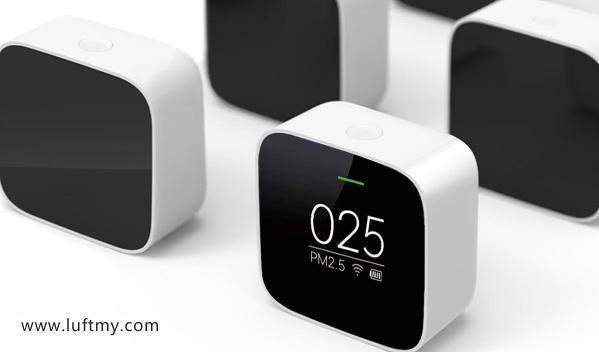
Luftmy air quality monitoring module PM2.5 detector is a dedicated detection instrument for measuring PM2.5 (fine particulate matter) values in the air. It is suitable for the determination of public environments, atmospheric environments, indoor air, and vehicle air, and can also be used for the evaluation and analysis of air purifier purification efficiency. The portable dust concentration sensor air quality monitoring module uses a laser PM2.5 sensor based on the Mie spherical particle scattering principle developed and produced by Luftmy, and adopts the POS particle swarm algorithm to invert the mass concentration of particulate matter. Data reading is fast and accurate.
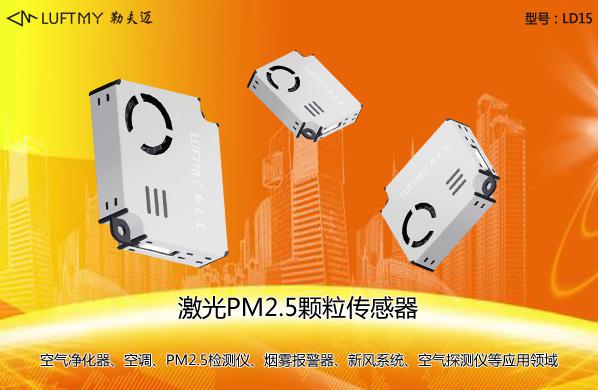
Luftmy air quality sensor model LD15 is a high-precision particle concentration sensor based on Laser Mie Scattering theory. It can continuously collect and calculate the number of suspended particles of different particle sizes in the air per unit volume, namely the particle concentration distribution, and then convert it into mass concentration and output it in the form of a general digital interface. Luftmy air quality sensor model LD15 features small size, high accuracy, strong anti-interference ability, low power consumption, long lifespan, zero false alarm rate, and short response time. This air quality monitoring sensor can be embedded in various instruments or environmental improvement equipment related to suspended particle concentration in the air, such as PM2.5 detectors, to provide timely and accurate concentration data.
