Technical Support:
158-7527-1139

With the rapid development of China's social economy, atmospheric pollution has intensified alongside the industrialization process. Smog has long become one of the air quality parameters for national prevention and control. China has successively released standards related to particulate matter monitoring instruments and methods. The State Council released the newly revised "Ambient Air Quality Standards," which added PM2.5 monitoring indicators for the first time.
I believe everyone is familiar with terms for inhalable particulate matter such as PM2.5, PM10, and even PM1. PM2.5 easily carries a large amount of toxic and harmful substances, which can enter and deposit in human alveoli. The organic pollutants like polycyclic aromatic hydrocarbons and heavy metals it carries can transfer to other parts of the body through the human circulatory system, having a significant impact on human health and air quality. Therefore, on the basis of strengthening population protection and reducing atmospheric particulate pollution, doing a good job in air pollution prediction and monitoring so that individuals can take protective measures to reduce the occurrence of systemic diseases will become the focus of future work.
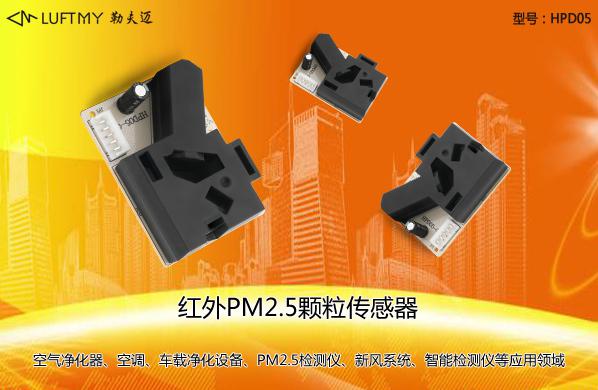
The trend of ambient air quality monitoring is gradually extending to city-wide monitoring of indoor air quality, with various inhalable particulate and gas sensors becoming the core of sensing technology. The quality of the sensor directly affects the final air quality monitoring values and plays a crucial role in governance and control. In recent years, China's dust PM2.5 particle sensors and dust monitoring technology have also developed rapidly. Products like the HPD05 infrared PM2.5 sensor provided by PM2.5 sensor supplier Luftmy are widely recognized by customers in fields such as air purifiers, fresh air systems, portable instruments, air quality monitoring equipment, air conditioners, and smart home devices. Below, the Luftmy editor will specifically introduce the relevant applications of PM2.5 sensors, using the Luftmy HPD05 PM2.5 PM1.0 sensor as an example:
Working Principle of Smog PM2.5 Sensor
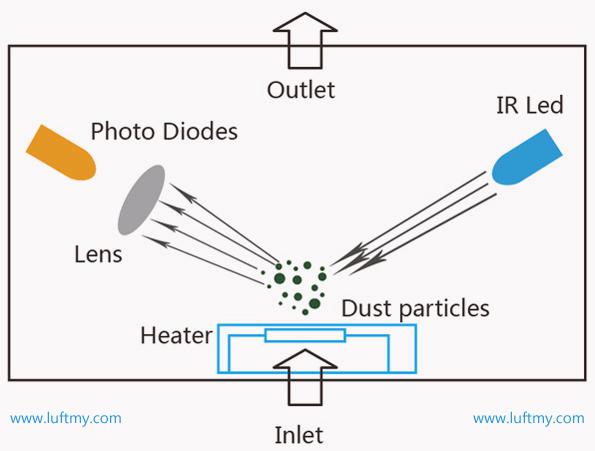
Particles and molecules cause light scattering and absorb part of the incident light energy under light irradiation, causing the light intensity to be attenuated. By detecting the degree of attenuation after light passes through the measured area, or the amount of scattering as light passes through, the concentration of dust in the area can be obtained.
From the working principle of dust sensors, it is known that the sensor measures dust in the optical channel. To obtain accurate data before and after light passes through the measured area (obtaining a single-valued function between the measured and measurement results), sensors usually make the measured area into a structure with a fixed size that is free from environmental interference. During measurement, the gas containing dust is sent inside the sensor for measurement. Therefore, dust on solid surfaces cannot be measured directly. However, dust stripped from solid surfaces can be measured—for example, by using the suction device of a dustiness tester with a micro-dust sensor application to suck up the dust and detect the amount of dust in the air passing through the device.
The PM2.5 / PM1.0 sensor - GPSM series launched by Luftmy HPD05 has strong performance consistency and high precision. Through Luftmy HPD05, ultrafine particles larger than 0.3㎛ can be detected, making PM2.5 / PM1.0 level classification more accurate. It can be embedded into various instruments or environmental improvement equipment related to suspended particulate matter concentration, such as smart homes, air conditioners, air purifiers, fresh air systems, air quality detection equipment, PM2.5 detectors, specialized PM2.5 sensors for vehicle air purification, air probes, wearable devices, etc., providing timely and accurate concentration data.
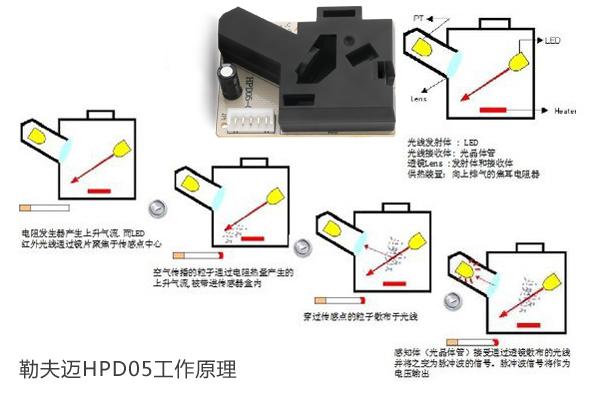
Infrared dust PM2.5 sensor supplier Luftmy's PM2.5 detection module HPD05 uses optical scattering principles to obtain particle concentration. Through optical and circuit conversion, it measures the dust concentration within the detection range. PM2.5 sensor supplier Luftmy's dust fine particulate concentration sensor HPD05 features a small size, high precision, low power consumption, short response time, and stable operation under high dust concentrations. This smog PM2.5 sensor can be applied in air purifiers, fresh air systems, etc.