Technical Support:
158-7527-1139

According to relevant survey results from health organizations, due to environmental pollution, the incidence of respiratory diseases, influenza, and respiratory infectious diseases in Chinese cities has remained high in recent years. The prevalence of these diseases has made people increasingly concerned about air quality. Products such as masks, air purifiers, and fresh air systems once triggered a buying spree, leading to the formation of a significant “air economy.” As a result, the previously obscure fresh air market has ushered in a new peak.
What is a fresh air system?
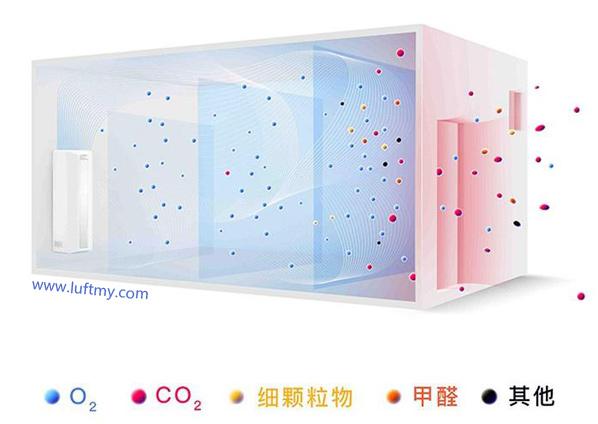
A fresh air system is a new type of indoor air purification equipment that achieves the exchange of indoor and outdoor air without opening windows through forced air supply and exhaust. The fresh air system is an open air circulation system that can continuously provide fresh oxygen-rich air indoors 24 hours a day. Luftmy editors have learned that residential buildings in Europe and America were popularized as early as the 1970s, and in recent years, it has been widely used in many domestic family residences, villas, and commercial houses.

What are the functions of a fresh air system:
1. Ventilation and effective oxygen enhancement
2. Filtering PM2.5 and effectively resisting haze.
3. Removing indoor harmful gases and protecting health.
4. Controlling indoor temperature, preventing dryness and removing moisture.
The role of PM2.5 sensors in fresh air systems:
One of the main functions of the fresh air system is to intelligently filter PM2.5 and haze from the air and purify it. The sensor module uses the principle of optical scattering to monitor and detect the concentration of dust in the air. The PM2.5 sensor has a built-in infrared light-emitting diode and a high-sensitivity photoelectric receiving sensor. The infrared LED emits light that reflects when it encounters dust, and the photoelectric sensor reflects the concentration of dust in the air by detecting the intensity of the reflected light. When the dust concentration in the air is too high, the fresh air system will automatically start the PM2.5 filtering function to achieve air purification.
With economic and social development, the living standards of the people are constantly improving, and environmental pollution problems have become increasingly serious, attracting widespread attention, especially the haze problem in North China. As the main component of haze, the detection of PM2.5 has also become the protagonist of environmental protection departments' air quality reports. Luftmy editors noted that China's current PM2.5 detection technology is quite mature, and air quality reports are updated in real-time.
The role of environmental monitors
Traditional PM2.5 environmental monitors are expensive and inconvenient to use, making them difficult to apply in homes. Various types of smart home PM2.5 environmental monitors with characteristics such as small size, portability, high cost-performance, and flexible use have emerged. These have built-in PM2.5 sensors and good detection effects, enabling real-time detection of PM2.5 and temperature/humidity suitable for home environments. Among these smart home monitors, Luftmy editors recommend the following PM2.5 sensors:
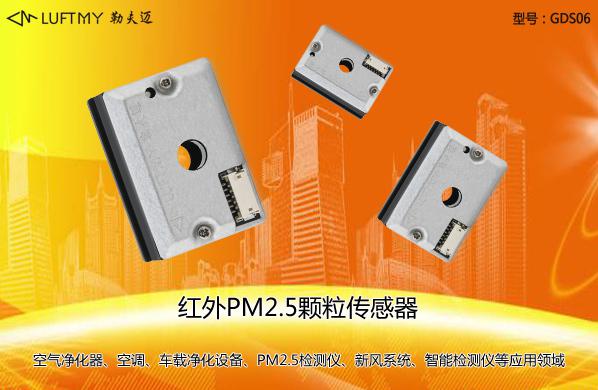
Luftmy, a manufacturer of air particulate sensors, offers the infrared counter sensor HPD05, which uses the principle of optical scattering to obtain particulate concentration. The intensity of light is proportional to the strength of the converted electrical signal. By measuring the electrical signal, the relative attenuation rate can be obtained, which in turn determines the concentration of dust in the measured field, followed by the application of a microcontroller for PWM and UART communication. The PM2.5 particle sensor manufacturer Luftmy's infrared counter sensor HPD05 features small size, high precision, low power consumption, short response time, wide measurement range, and convenient application. This particulate detection sensor can be used in air purifiers, fresh air systems, PM2.5 monitors, environmental monitors, etc.
Luftmy digital laser dust sensor LD15 is a high-precision particulate concentration sensor based on laser Mie scattering theory. It can continuously collect and calculate the concentration distribution of particulates and output it in the form of a general digital interface. The laser particle counter LD15 features small size, high precision, strong anti-interference ability, low power consumption, long life, zero error alarm rate, and short response time. Particulate detection sensor manufacturer Luftmy's laser particle counter LD15 can be embedded in various instruments or environment improvement equipment related to the concentration of suspended particulates in the air, such as PM2.5 monitors and fresh air systems, to provide timely and accurate concentration data.
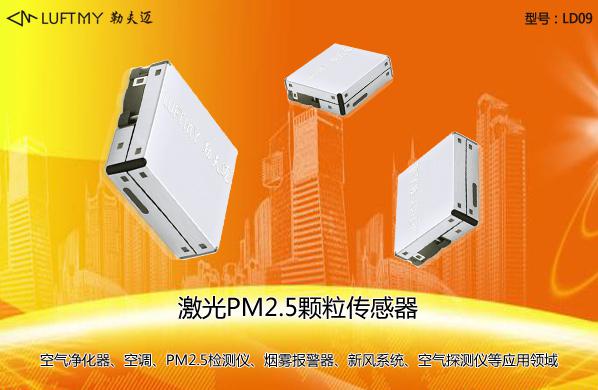
Luftmy focuses on the research, production, and sales of optical particulate sensor technology. Luftmy sensors have received wide acclaim in the industry for multiple performance indicators such as measurement accuracy, stability, consistency error, and anti-interference.