

Technical Support:
158-7527-1139

Air quality sensors are commonly used to monitor pollutants in the air and are an important component of air purifiers and fresh air systems. Although not well-known to consumers, they are crucial to the entire industry. The development of sensor technology in China has historically lagged behind other countries, but with technological innovation and the unremitting efforts of domestic sensor companies, the application of air quality sensors has opened up a new situation, far exceeding foreign technical levels.
I. Monitoring of Particulate Matter
The full-scale application of air purifiers in China began with the outbreak of smog, and PM2.5 sensors were the first to be recognized by the public. Early PM2.5 sensors were simple infrared gas detectors with a level output, using red, yellow, and green indicator lights to show air conditions. National standards stipulate that when the PM2.5 concentration in the air is below 35μg/m3, it is classified as excellent and displayed in green. However, some manufacturers cheated by changing the defined values; for example, setting the green light to show when PM2.5 was below 100μg/m3. Consumers seeing the indicator change from red to yellow and then green would believe the particulate concentration had dropped to a safe range, thus deceiving the public.
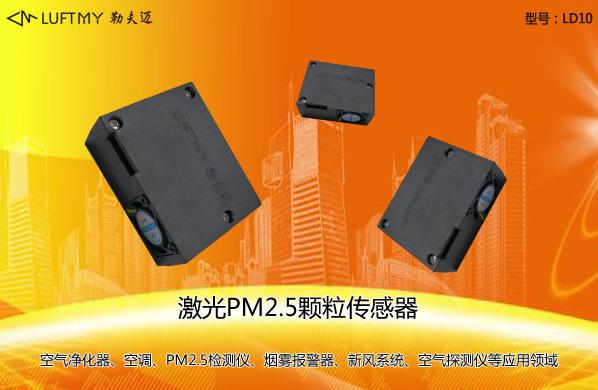
With the upgrade of domestic sensor technology, the analog qualitative output of sensors has been transformed into quantitative output, directly displaying the PM2.5 concentration. This has achieved the digitalization of air quality, leaving no room for companies to cheat and allowing consumers to understand air quality more intuitively, further promoting the healthy development of the purifier industry.
The Particulate Matter Sensor manufacturer LUFTMY's air quality sensor LD10 is a high-precision particulate matter concentration sensor based on Laser Mie Scattering theory. It can continuously collect and calculate particle concentration distribution and output it via a universal digital interface. The Particulate Matter Sensor LD10 features small size, high precision, strong anti-interference ability, low power consumption, long life, zero false alarm rate, and short response time. The LUFTMY PM fine particulate matter sensor / air flow sensor LD10 can be embedded in various instruments or environmental improvement equipment related to the concentration of suspended particles in the air, providing timely and accurate concentration data.
2. Application Trends of Particulate Matter Sensors
As is well known, the smaller the particle size, the greater the harm the attached bacteria cause to the human body. PM2.5 can enter the bloodstream, and its attached harmful substances can cause cancer. While PM10 does not enter the alveoli directly like PM2.5, it can damage the throat and airways. PM1.0 causes even greater harm.
Currently, many European and American countries are paying more attention to PM10 pollution, and South Korea has included PM1.0, PM2.5, and PM10 monitoring into its national standards. China is also undergoing a consumption upgrade, promoting the in-depth development of the purifier industry by monitoring multiple concentration parameters such as PM1.0, PM2.5, and PM10. This places higher demands on air purifiers: first, the filters must not only remove PM2.5 but also have the capacity to handle smaller particles; second, sensors must not only perform multi-channel measurement but also achieve low noise, long life, and high reliability.
1) Low Noise
Previously, a noise level of 60-70 decibels in an air purifier was considered normal, but now there are higher requirements: it must achieve both high air volume and low noise. For laser sensors, noise mainly comes from the rotation of the fan, making fan selection very important. Before production, fans need to undergo strict silent test screening, and the sensor itself must undergo a second silent test.
2) Long Lifespan
The lifespan of existing sensors is limited by the laser tube, generally around 20,000 hours; if working continuously, the service life is less than three years. Now, by upgrading core components, the sensor life can be extended to 80,000 hours, allowing for nearly ten years of use.
3) High Reliability
How to ensure that the accuracy of the sensor does not change significantly after long-term operation is a question every sensor company must consider. Compared to infrared sensors, laser sensors have better dust-proof effects. This problem can be effectively solved through innovative designs in the sensor structure and air ducts.
II. Rising Attention to Formaldehyde Pollution
The improvement of the atmospheric environment has affected the sales of purifiers intended solely for haze removal. Many purifier companies have begun to focus on formaldehyde treatment and monitoring data displays. Companies like A.O. Smith have launched formaldehyde digital display purifiers, which solve the rigid needs of consumers and have been warmly welcomed by the market.
Formaldehyde sensors have long faced issues such as high price, short lifespan, and susceptibility to interference, and the demand awareness among air purifier companies was not obvious, so they were not fully promoted. Cubic Sensor and Instrument Co., Ltd. ("Cubic"), as a national high-tech enterprise specializing in the R&D, manufacturing, and sales of gas sensors, has deep R&D strength. Since 2010, it has been committed to the research of formaldehyde sensors to solve problems in application, aiming to make them both affordable and effective. Currently, it has reached cooperation with many domestic and foreign purifier companies.
2. Application Trends of Formaldehyde Sensors
Formaldehyde sensors generally face difficulties such as short life, high cost, significant gas cross-interference, and difficulty in transport and storage.
III. CO2 is an Invisible "Killer"
CO2 is ubiquitous in indoor air but is often ignored. Although colorless, odorless, and non-toxic, it can still harm people invisibly. When the CO2 in indoor air reaches 1000ppm, the human body feels discomfort; at 2000ppm, it belongs to slight hypoxia, causing shortness of breath, headache, and dizziness. At 5000ppm, it is a health limit environment, where bodily functions are severely disordered, leading to loss of consciousness and confusion. Therefore, the harm of CO2 to the human body cannot be ignored.

In Europe, CO2 is a mandatory indicator for fresh air systems, and in recent years, China has paid more and more attention to it. Whether CO2 concentration can be reduced is an important test for fresh air systems. However, the technical threshold for CO2 sensors is relatively high; there are no more than ten companies internationally that make CO2 sensors, and domestic companies are rare.
Furthermore, CO2 sensor applications need to satisfy the following characteristics:
1) Small size: The smaller the size, the larger the application space;
2) Low power consumption: Must meet the standby power requirements of household appliances;
3) Low cost: To make the CO2 sensor a standard configuration for fresh air systems.
IV. Application Trends of Air Quality Sensors
While technical upgrades continue in household air purifiers, fresh air systems, and air conditioners, domestic companies are also exploring more development paths, bringing air quality monitoring technology to more life scenarios, such as gas monitoring in the automotive field. As a confined travel space, cars also face air pollution problems such as excessive particulate matter, formaldehyde, and CO2, which threaten consumer health.
