

Technical Support:
158-7527-1139


With the improvement of living standards, people's attention to air quality is increasing, especially as winter approaches and haze weather occurs more frequently. PM2.5, as the main component of haze, has begun to be widely noticed, and detection equipment for PM2.5 in the air has emerged endlessly. In the current field of PM2.5 particulate matter detection, the Luftmy editor noticed that two types of dust sensors are mainly used: infrared pm2.5 sensors and laser dust sensors.
1. Structure and principle analysis of pm2.5 infrared dust sensors and laser dust sensors:
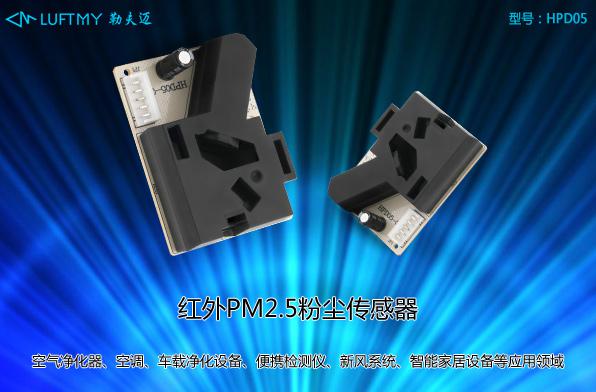
The structure and circuit of the infrared pm2.5 sensor are relatively simple. Its light source is an infrared LED. The airflow enters and exits the vent mainly by resistance heating to obtain thermal airflow. When particles pass through, it outputs a high level, and the output signal includes PWM models.
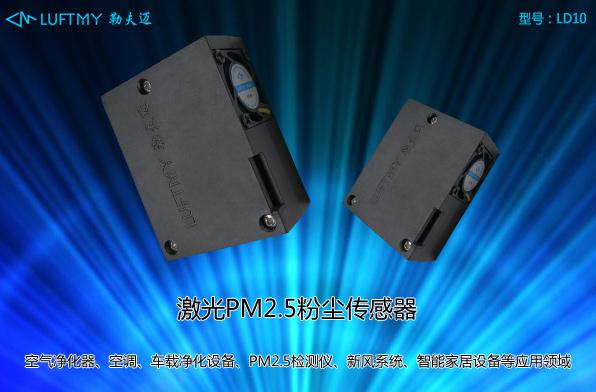
The structure and circuit of the laser dust sensor are relatively complex. Its light source is a laser diode. The sampled air is pushed by a fan or blower through a complexly designed air duct for detection. When fine particles in the air enter the area where the laser beam is located, they cause the laser to scatter; scattered light radiates at 360° in space. We place a photodetector at an appropriate position so that it only receives the scattered light, which then generates a current signal through the photoelectric effect of the photodetector. After circuit amplification and processing, the concentration value of fine particles can be obtained. The output signal is generally a serial port output.
2. Measurement accuracy analysis of laser dust concentration sensors and infrared pm2.5 sensors
Infrared principle pm2.5 infrared dust sensors can only detect particles above 0.5 microns. In contrast, laser dust concentration sensors can detect particles above 0.1 microns.
3. Application scenario analysis:
Infrared dust sensors are mainly used for dust in industrial and mining areas. The detection objects are particles with large diameters and high concentrations, and the detection level is mg/m3, making it impossible to accurately measure the concentration of PM2.5. Laser-principle dust particle concentration sensors are mainly used in the PM2.5 detection field to quantify PM2.5 mass with precision. They can be embedded in household (vehicle, handheld) air detectors and air purifiers. In addition, laser principle sensors are also applied in IoT data collection, environmental quality testing, and other fields.
Development Trend: Before laser principle sensors entered the civilian field, the Luftmy editor noticed that air purifiers extensively used infrared sensors. However, with the development of the air purification industry, the cost of laser principle sensors is gradually decreasing, and terminal customers' requirements for accurate measurement of air quality are getting higher. Using laser principle sensors to accurately quantify PM2.5 mass has become a recognized trend in the industry. Currently, many air purifiers have adopted laser sensors.
Infrared pm2.5 sensors and laser dust sensors each have their own advantages, so there is no definitive answer as to which PM2.5 sensor is better. It all depends on the customer's needs (such as cost requirements, accuracy, signal output, application site, and the relevant particles to be tested) to choose the suitable detector.
