

Technical Support:
158-7527-1139


Every household cannot do without a kitchen. Steaming, boiling, frying, stir-frying – everything is possible. But a kitchen full of delicious aromas and heat can also be highly polluted, and what you see as steaming is actually composed of fine particles, which are the main components of indoor air pollution. Chinese culinary culture emphasizes frying, stir-frying, and deep-frying, especially stir-frying or deep-frying, which can significantly increase the content of fine particulate matter in the air.
Traditional range hoods can almost be divided into two types: one is the old-style manual range hood that requires you to turn it on and off yourself, and the other is the newer semi-intelligent range hood that automatically turns on and off by sensing smoke or gas. However, the drawbacks of both types are obvious. With manual range hoods, people typically turn them on while cooking and off immediately after finishing. Automatic range hoods only activate when smoke or gas is detected. In fact, at this time, PM2.5 pollution in the kitchen is still significant, but traditional range hoods cannot detect it. This causes long-term exposure to particulate pollution, which can seriously affect our health.
Luftmy editorial staff learned from a UK research report that cooking for one hour on stoves with poor ventilation and low combustion efficiency causes health damage equivalent to smoking two packs of cigarettes daily.
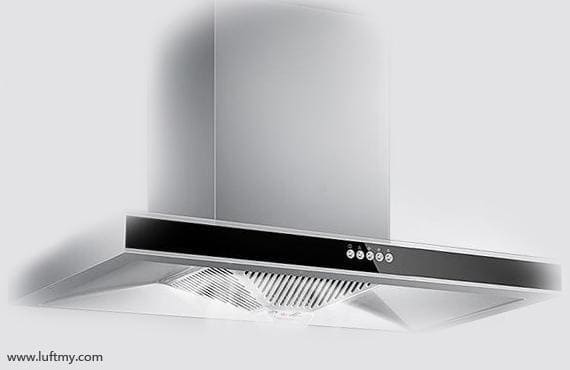
Turning on the range hood while stir-frying and turning it off immediately after finishing is almost common practice for everyone. However, this quick shutdown is quite problematic. Experts point out that if the stove flame is particularly high and food is burned, harmful substances are released, posing risks to the respiratory system and potentially triggering lung cancer. Therefore, do not turn off the range hood immediately after cooking.
After careful research, Luftmy editorial staff noted that range hoods equipped with a PM2.5 sensor can efficiently solve the PM2.5 pollution problem by monitoring real-time PM2.5 levels in the kitchen and controlling the actual shutdown time of the range hood. This prevents excessive PM2.5 residues and maintains optimal kitchen air quality. Therefore, range hoods paired with PM2.5 sensors will be a major development direction for intelligent kitchen range hoods in the future.
