

Technical Support:
158-7527-1139

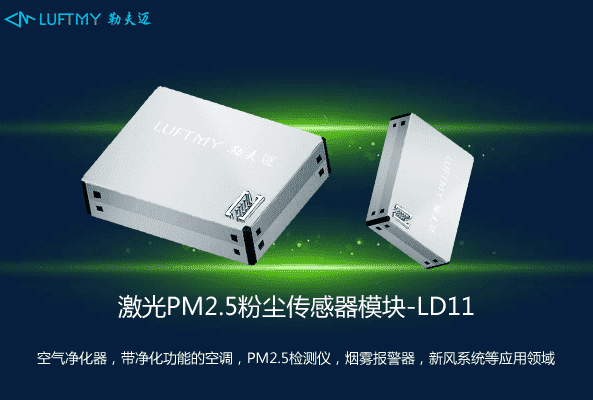
1. Product Name: Luftmy Laser Dust PM2.5 Sensor Module
2. Product Model: LD11
The PM2.5 Laser Dust Sensor LD11 is a high-precision particle concentration sensor based on the laser Mie scattering theory. It can continuously collect and calculate the number of suspended particles of different sizes per unit volume of air and output the data via a universal digital interface. It can be embedded into various devices related to air suspended particle concentration, such as smoke detectors, air purifiers, or environmental improvement equipment, providing timely and accurate concentration data.
3. Applications of Dust Sensor LD11:
Smoke detectors, air purifiers, fresh air systems, air conditioners with purification functions, PM2.5 detectors, range hoods, dedicated PM2.5 sensors, air monitoring devices, wearable devices, etc.
4. Features of Dust Sensor LD11:
1. High measurement accuracy;
2. Real-time response time less than 1 second;
3. Long lifespan, mean time between failures ≥ 5 years;
4. Strong anti-interference capability;
5. High consistency;
6. Wide measurement range, outputs PM0.3, PM0.5, PM1.0, PM2.5, PM10 simultaneously;
7. Slim design, suitable for detectors, wearable devices, air purifiers, and fresh air systems.

5. Technical Specifications of Dust Sensor LD11:
Detection Principle: Mie spherical scattering principle
Particle size detection range: 0.1~10μm
PM2.5 output consistency: >100μg/m³ max error ±8%, <100μg/m³ max error ±10μg/m³
Operating Conditions: -10~70°C, 0~95% RH
Storage Conditions: -40~80°C, 0~95% RH (non-condensing)
Operating Voltage: DC 5.0V±5%
Operating Current: <60mA
Standby Current: <0.5mA
Output Signal: UART, PWM
Dimensions: W48*H37*D12 (mm)
6. Working Principle:
The sensor uses a laser to illuminate suspended particles in the air, producing light scattering. A photodetector collects scattered light intensity within a certain angle range, converts it linearly to voltage, and sends it to a data processing system. The system processes the data according to Mie scattering theory to determine the equivalent particle size and number of particles of different sizes per unit volume.
