

Technical Support:
158-7527-1139

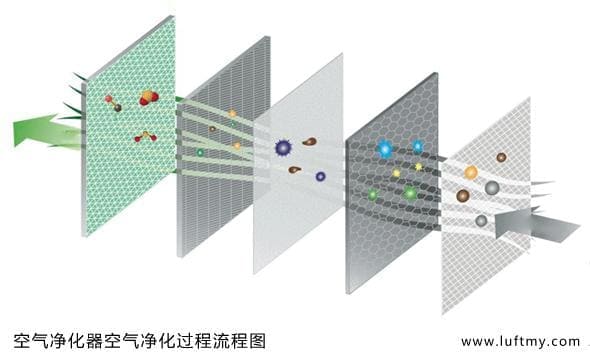
Air pollution can reduce the air quality we breathe, leading to health issues. Certain daily activities may release harmful gases, which in extreme cases, such as carbon monoxide, can be fatal. Therefore, air purifiers are increasingly entering everyday households, and PM2.5 sensor modules and other gas sensors are attracting growing interest from dust sensor module manufacturers. With rising public awareness of environmental protection, particle sensor modules and other gas sensors are creating new applications and market opportunities, including consumer products such as smart homes, wearable devices, and in-car air purification equipment.
The Luftmy editor learned from relevant research institutions that the market is projected to reach USD 920 million in 2021, with a compound annual growth rate (CAGR) of 7.3% over the next five years. If particle sensor modules and other gas sensors are widely applied in consumer products, along with rapid development of the Internet and IoT, gas sensors will see rapid growth in emerging fields such as smart homes and smart mobile terminals, greatly expanding application space and significantly increasing demand.
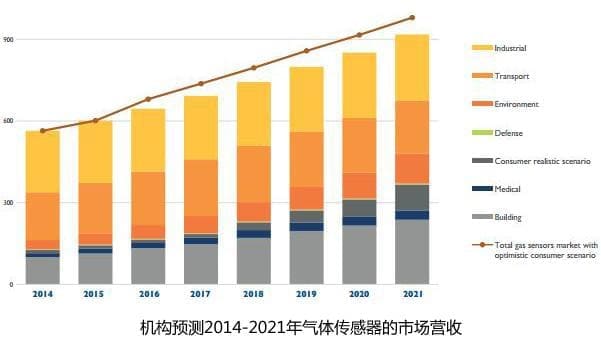
1. Driven by better energy management needs, gas sensors in the building market will experience rapid growth, with a five-year CAGR of 13.6% and market revenue of approximately USD 237 million in 2021.
2. The medical industry requires high-sensitivity asthma detection sensors and oxygen sensors for respiratory control.
3. Consumer applications, such as smart homes, wearable devices, and smartphones, are driving the development of new MEMS gas sensors to reduce cost, power consumption, and size.
4. Due to public demand for outdoor air quality control, the environmental protection market is expected to achieve a five-year CAGR of 19%.
5. The transportation market is mainly driven by oxygen sensors, with the goal of reducing vehicle emission pollution.
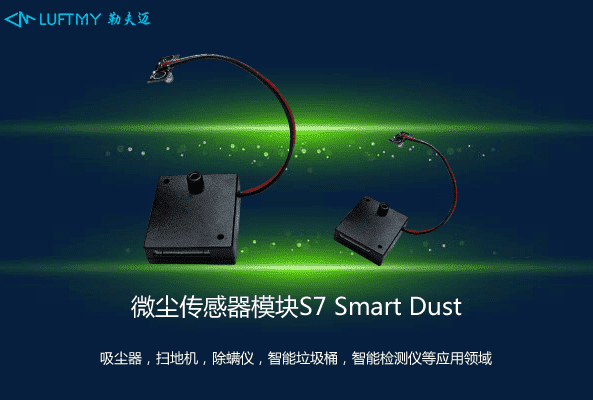
The consumer market is very attractive because it can generate significant market size, depending on user adoption, product cost, and technology maturity. Today, the smartphone industry has completely transformed the sensor industry by integrating a wide variety of sensors. The micro-dust sensor S7 Smart Dust developed and produced by Luftmy shows application benefits in vacuum cleaners and robotic floor cleaners:
1. The device's suction cleaning performance and cleanliness of floors, carpets, bed sheets, etc., are visually displayed to users via sensor output data and LED color indicators;
2. The device intelligently controls motor speed based on sensor data to achieve quiet, energy-saving operation and prolong motor life.
Gas sensors are widely used in industrial and daily life fields such as petroleum, chemicals, steel, metallurgy, mining, environmental protection, municipal services, medical, and food industries. Each application has specific technical requirements, including gas type, sensitivity, response time, lifespan, and power consumption, as well as business requirements such as regulations, target pricing, market maturity, and competition.
Six major submarkets of gas sensors:
1. Consumer market: integrated into consumer electronics, including smart homes, wearable devices, and smartphones;
2. HVAC market: gas sensors for indoor/in-vehicle air quality monitoring;
3. Transportation market: gas sensors for vehicle exhaust measurement or heavy vehicle engine control;
4. Medical market: gas sensors for respiratory analysis during treatment and care;
5. Defense and industrial safety market;
6. Environmental market: gas sensors for monitoring air quality and pollution.
Gas sensor technology is diverse, with nine different methods. Generally, the choice of gas sensor technology depends on price, size, power consumption, sensitivity, and response time.
Metal oxide semiconductor technology is widely used, covering medical, transportation, HVAC, and consumer products, and has a long service life (5–10 years). Catalytic and electrochemical technologies are “older” technologies with shorter lifespans (under 5 years), mainly for defense and industrial safety. Optical technology offers the highest accuracy and longest lifespan, but due to high cost and harsh environments, it is not widely applied in transportation but favored in HVAC, especially non-dispersive infrared sensors. With further integration, optical technology will also open the portable industrial inspection systems market.
