

Technical Support:
158-7527-1139

Inhalable particulate matter usually refers to particles with a diameter of less than 10 micrometers, also known as PM10. Inhalable particulate matter remains in the ambient air for a long time and has a significant impact on human health and atmospheric visibility. Once inhaled, these particles accumulate in the respiratory system, triggering many diseases. Therefore, many cities now measure PM10 particles in the environment. Below, the Luftmy editor will introduce the determination methods for inhalable PM10 particles.

Sources of PM10 Particles:
Inhalable particulate matter is one of the important pollution sources in air pollution, usually coming from motor vehicles driving on unpaved asphalt or cement roads, material crushing and grinding processes, and wind-blown dust. There are two main ways for the formation of inhalable particles: first, ultrafine particles directly emitted by various industrial processes (coal combustion, metallurgy, chemical industry, internal combustion engines, etc.); second, ultrafine particles and aerosols formed secondarily in the atmosphere.
Determination Methods for Inhalable PM10 Particles:
Scope: This standard specifies the concentration and quality control requirements for determining inhalable particulate matter in public places using a light-scattering dust meter (PM10) as an example. This standard is applicable to the rapid determination of PM10 concentration in public places, as well as in other indoor air environments.
Reference Standards: The provisions contained in the following standards constitute provisions of this standard through reference. At the time of publication, the versions shown were valid. All standards are subject to revision, and parties using this standard should explore the possibility of using the latest versions of the following standards.
GB/T 17095-1997 Hygienic Standard for Inhalable Particulate Matter in Indoor Air
JJG 846-1993 Verification Regulation of Light Scattering Digital Dust Tester
LD 98-1996 Light Scattering Method for Determination of Dust Concentration in Air
Definitions: This standard adopts the following definitions:
1. Inhalable Particulate Matter (PM10) refers to particles with a mass median diameter of 10μm that can enter the respiratory tract (D50=10μm).
2. Mass Concentration
The amount of inhalable particulate matter (PM10) contained in a unit volume of air (mg/m3).
3. Relative Mass Concentration
The measured value of the instrument that is linearly related to the mass concentration (counts per minute, CPM).
4. Mass Concentration Conversion Factor K
The ratio of the mass concentration of inhalable particulate matter (PM10) in the air to the relative mass concentration measured by the instrument.
5. Relative Overall Uncertainty (ROU)
Within the range of 0.5 to 2 times the concentration specified by the hygiene standard, the total uncertainty should be less than or equal to 25% when comparing the light scattering method with the filter paper (membrane) sampling-weighing method.
The mathematical expression is shown as:
ROU=[|b|+2|MRSD|]≤25% …………………………(1)
Where: b — the arithmetic mean of the relative differences determined by the two comparison methods;
MRSD — the geometric mean of the relative standard deviation determined by the light scattering method.
Principle of PM10 Determination:
When light shines on particles suspended in the air, scattered light is produced. Under certain particle properties, the intensity of the scattered light is proportional to its mass concentration. By measuring the scattered light intensity and applying the mass concentration conversion factor K, the particle mass concentration is obtained. For the determination of PM10 particles, Luftmy provides the GDS06 infrared sensor, HPD05 infrared sensor, and laser particle sensor series, all of which can effectively monitor particles in the air.
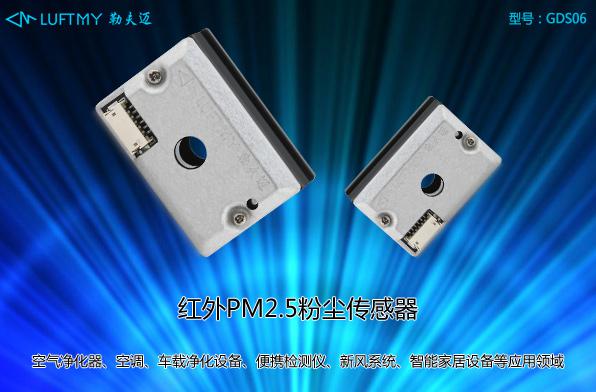
Luftmy infrared particle sensors can detect particles from 0.3㎛ to 10㎛, and laser particle sensors can detect particles from 0.1㎛ to 10㎛. This allows them to subdivide PM2.5/PM10 more accurately than existing sensors. Compared to traditional sensors, the laser particle sensor series has higher precision and sensitivity, providing users with reliable information for more precise and detailed control of air purifiers, air conditioners, and air quality testing equipment.
