

Technical Support:
158-7527-1139

With the development of artificial intelligence, some electronic devices have made greater breakthroughs in automation and data processing capabilities. Traditional sensors can no longer meet the needs of electronic devices. With the arrival of the smart era, smart sensors have become a new market demand. Smart sensors are equipped with microprocessors and have the ability to collect, process, and exchange information. They are the product of combining sensor integration with microprocessors. What are the advantages of smart sensors compared to ordinary sensors?
Advantages of Smart Sensors:
High Precision: Smart sensors have information processing functions. Through software, they can not only correct various deterministic systematic errors but also appropriately compensate for random errors and reduce noise, greatly improving sensor accuracy.
High Reliability: The miniaturization of integrated sensor systems eliminates certain unreliable factors of traditional structures and improves the anti-interference performance of the entire system. At the same time, it has diagnostic, calibration, and data storage functions (self-adaptive functions for smart structural systems), providing good stability.
High Cost-effectiveness: Under the same precision requirements, multi-functional smart sensors have a significantly improved price-performance ratio compared to single-function ordinary sensors, especially after using cheaper microcontrollers.
Multi-functionalization: Smart sensors can achieve multi-sensor and multi-parameter comprehensive measurement, expanding the measurement and usage range through programming. They have a certain self-adaptive ability to change the range or output data format according to changes in detection objects or conditions. They feature digital communication interfaces to send data directly to remote computers for processing and have multiple data output forms to suit various application systems. A good ‘smart sensor’ is a sensor and instrument kit driven by a microprocessor, with communication and on-board diagnostic functions.
Applications of Smart Sensors:
Smart sensors are widely used in aerospace, aviation, national defense, science and technology, and industrial and agricultural production. For example, they have broad application prospects in the field of robotics, enabling robots to have human-like senses and brain functions to perceive phenomena and complete actions.
In industrial production, traditional sensors cannot perform fast, direct measurement and online control of certain product quality indicators. In the medical field, a “Glucose Watch” with a built-in smart sensor looks like an ordinary watch but can achieve painless, bloodless, and continuous blood sugar testing.
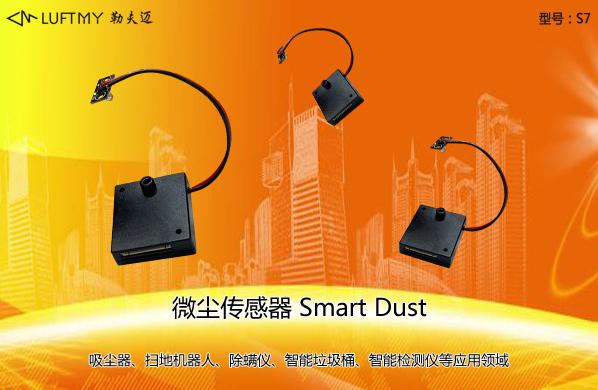
In addition, smart sensors are found in dust mite controllers, vacuum cleaners, and sweeping robots that we often use in our lives. The S7 Smart Dust sensor developed by Luftmy can be installed in these devices to accurately measure the number and concentration of particles such as mites, dust, and hair fibers, and display real-time cleanliness data for floors, carpets, sheets, sofas, and car interiors. It is evident that smart sensors are already widely used in our lives.
