Technical Support:
158-7527-1139

Smog is common in cities. Many regions in China include fog and haze together as a disastrous weather phenomenon for early warning and forecasting, collectively known as “smog weather.” Does smog belong to dust? Smog is the result of the interaction between specific climatic conditions and human activities. The economic and social activities of high-density populations inevitably emit large amounts of fine particulate matter (PM 2.5). Once emissions exceed the atmospheric circulation capacity and carrying capacity, the concentration of fine particulate matter will continue to accumulate. At this time, if affected by static weather, large-scale smog is very likely to occur. How to use sensors to prevent PM2.5 in smog?

Main Causes of Smog Formation:
1. Stagnant air or poor circulation is the main factor of smog. Lack of movement causes tiny particles to gather in the air. This is why smog dissipates when cold air arrives.
2. Large amounts of polluted waste gas emitted from factory chimneys. Smog can be summarized in one sentence as atmospheric pollution! The main source of pollution is these heavy industries.
3. Vehicle exhaust emissions. As the number of cars in cities increases, so do exhaust emissions, which naturally worsens the air quality.
4. Low air humidity. The movement of people and cars kicks up dust on the ground, especially common at construction sites.
Harm of Smog to the Human Body:
Since the diameter of floating fine powder particles in haze is generally below 0.01 microns, they can directly enter the bronchi and even the lungs through the respiratory system. Therefore, haze has the greatest impact on the respiratory system, causing diseases such as respiratory tract infections, cerebrovascular diseases, and nasal inflammation.
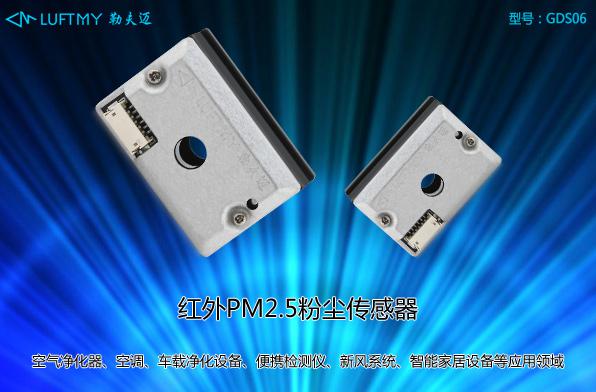
In the current field of air purification, air quality sensors have become almost standard accessories for purification equipment. Their role is to monitor the concentration of PM2.5 and other particles. A constant light source (such as an infrared LED) inside the sensor scatters when particles pass through, causing attenuation of light intensity proportional to the concentration. This allows the determination of dust concentration for PWM or UART communication.
The LUFTMY GDS06 infrared PM2.5 dust sensor is applied to air quality sensors with its small size, anti-dust accumulation, high-precision output, and convenient application. To obtain product specifications or sample applications, please contact customer service or leave a message online.