

Technical Support:
158-7527-1139

Detailed working principle of the dust particle counter sensor: Light from a source is focused into the measuring chamber by a lens. As each particle in the air passes quickly through the measuring chamber, the incident light is scattered once to form an optical pulse signal. This light signal is sent to a photodetector, converted into an electrical pulse signal, and then amplified and screened by instrument electronics to obtain the required signal and display it through a counting system.

Particles in the air scatter under light. This phenomenon is called light scattering. Light scattering is related to particle size, light wavelength, the refractive index of the particle, and the particle's light absorption characteristics. However, regarding the intensity of scattered light and the size of air particles, there is a basic rule: the intensity of a particle's scattered light increases as the particle's surface area increases. Therefore, by measuring the intensity of scattered light, the particle size can be inferred, which is the basic working principle of light-scattering particle counters.
In fact, each particle generates a weak scattered light intensity. This is a very small light pulse that needs to be amplified by an optoelectronic converter, converting the light pulse into an electrical pulse with a larger signal amplitude, which then passes through electronic circuits for further amplification and filtering, thus completing the count of a large number of electrical pulses. At this point, the number of electrical pulses corresponds to the number of particles, and the amplitude of the electrical pulses corresponds to the size of the particles.
Understanding the working principle of the laser dust particle counter allows for better data testing during use, ensuring data accuracy and stability.
The PM2.5 detector is a specialized instrument used to measure PM2.5 (fine inhalable particulate matter) values in the air. It is suitable for measuring public environments, atmospheric environments, indoor air, and vehicle interiors, and can also evaluate the purification efficiency of air purifiers. The air particle counter uses a laser PM2.5 sensor developed and produced by LUFTMY based on the Mie scattering principle of spherical particles, employing the POS particle swarm algorithm to invert particulate mass concentration, making data reading fast and accurate.
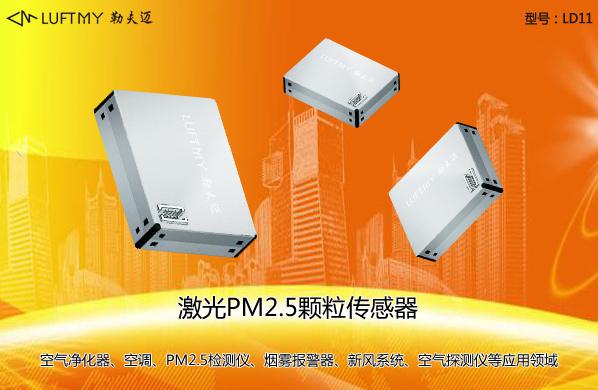
Particle sensor manufacturer LUFTMY's laser digital PM2.5 sensor LD11 is a high-precision particulate concentration sensor based on Laser Mie Scattering theory. It can continuously collect and calculate the number of suspended particles of different sizes per unit volume of air (i.e., particle concentration distribution), convert them into mass concentration, and output them via a universal digital interface. The LUFTMY particle counter LD11 features small size, high precision, strong anti-interference ability, low power consumption, long life, zero false alarm rate, and short response time. This air particle counter can be embedded in various instruments related to suspended particle concentration, such as indoor air quality detectors, PM2.5 detectors, or environmental improvement equipment, to provide timely and accurate concentration data.
