

Technical Support:
158-7527-1139

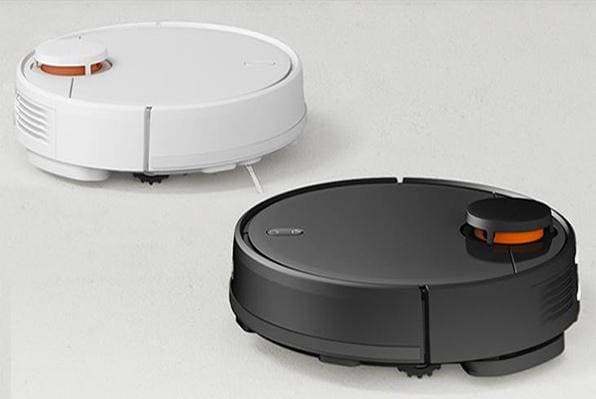
In the era of information intelligence, sweeping robots are no longer unfamiliar and have entered many households. With the improvement of consumption levels, demand is increasing daily. Their existence helps us further reduce the time spent on housework and improve life efficiency. Choosing the most important sweeping robot still needs to match the actual needs of the home, choosing products with qualified quality and the most suitable features. The application of sweeping robot dust identification sensors, also known as dust sensors or micro-dust sensors, makes sweeping robots smarter, providing cleanliness output data and LED color displays intuitively to the user.
I. The role of sweeping robots with dust identification sensors
The purpose of dust sensors or vacuum cleaner dust identification sensors and dust particle sensors is that when the sensor detects particles continuously hitting the sensor plate, the machine determines that there is more dust in that area and will start the spot cleaning mode to repeat cleaning in that area to better clean the dust and garbage. Through dust sensing technology, the dust sensor displays data to achieve real-time cleanliness display, which is presented more intuitively to the user, improving the application capability of the sweeping robot.
II. Measuring the intelligence of sweeping robots
Compared to ordinary sweeping robots with random cleaning, intelligent sweeping robots appear more organized in cleaning under route planning. Through area division, sweeping robots can enter various rooms indoors and even clean under some furniture without going back and forth in the same place repeatedly.
Dust sensing capability and dust identification are also important features of an intelligent sweeping robot. Through the built-in sensing device of the robot, the machine can identify large pieces of garbage and dust indoors and stay in key areas for repeated cleaning. The dust sensing function further enhances the cleaning efficiency of the sweeping robot.
For an intelligent sweeping robot, its sensing function must be powerful enough. Luftmy editor has learned that most robots are scheduled to clean when no one is home. To further extend the lifespan of the robot, its anti-drop and anti-collision sensing capabilities must also be sensitive enough.
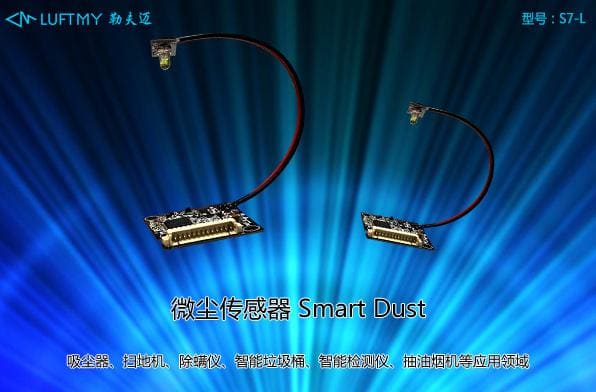
III. Sweeping robot dust identification sensor S7-L Smart Dust micro-dust sensor
The sweeping robot dust identification sensor micro-dust sensor S7-L Smart Dust product utilizes the optical transmission principle to accurately detect the quantity and concentration data of particles in the ventilation ducts of equipment such as vacuum cleaner handles or extension poles, sweeping robots, range hoods, and particle detection instruments.
Application benefits of micro-dust sensor S7-L Smart Dust in vacuum cleaner and sweeping robot products:
1. The dust cleaning effect of the equipment and the cleanliness of floors, carpets, bed sheets, etc., are intuitively presented to the user through sensor output data and LED color displays;
2. The equipment intelligently controls the motor speed according to the sensor data, achieving quiet operation, energy saving, and extending motor life;
Luftmy micro-dust sensor S7-L Smart Dust product features:
1. The product adopts a separate structure for transmission and reception, featuring a small size that is convenient for users to flexibly install and use in various complex structures;
2. High measurement accuracy for moving particles, with a minimum detectable particle size of 10um at a wind speed of 12m/s;
3. High measurement sensitivity, with a response time of less than 0.6s;
4. Wide measurement range: available in two range options, 0-999 and 0-9999;
5. Low power consumption: working current less than 30mA, sleep current less than 0.5mA.
6. The output interface includes particle concentration LED driving levels consisting of 3 pins for 7 colors, allowing for external LED indicators;
7. Data particle concentration output interface: PWM and UART can provide accurate micro-dust concentration data in real-time for equipment such as vacuum cleaners and sweeping robots.
