

Technical Support:
158-7527-1139

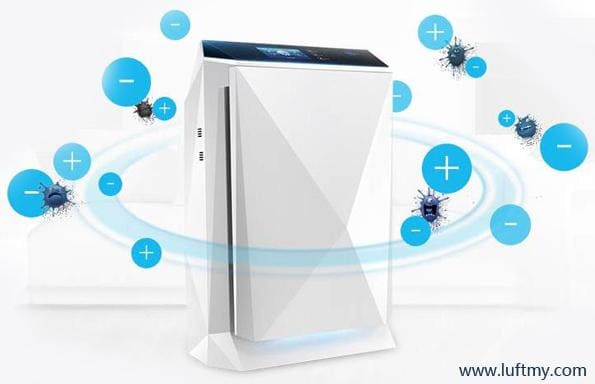
Through the different colors displayed by the LED indicator of an air purifier or the values shown on the purifier's LCD screen, we can easily grasp the air quality of our space in real-time. This is very convenient, but how is it achieved? There are many tiny particles in the air that enter our bodies along with our breath, yet they are invisible to the naked eye.
While purifying the air, an air purifier can also display air quality in real-time through values or colors. This is primarily realized by a component called the indoor particulate matter PM2.5 sensor.
Inside the PM2.5 sensor, there is a device called a constant light source. When air passes through the light it emits, particles in the air scatter the light, causing attenuation of light intensity. The relative attenuation rate is proportional to the concentration of particulate matter. Then another component comes into play——the light detector, which can detect the light reflected by the particles and output a signal based on the intensity of the reflected light, thereby determining the concentration of the particles.
The internal structure and circuit design of PM2.5 dust infrared sensors are relatively simple. They use infrared light-emitting diodes as light sources. The airflow in and out of the vent mainly relies on resistance heating to drive surrounding gas flow. Phototransistors are used to receive reflected light and output PWM signals. This signal cannot be displayed intuitively and requires further calculation to derive the particulate concentration range.
Due to the characteristics of infrared light itself and its simple internal structure, infrared sensors have the following characteristics: low cost, simple principle implementation, relatively accurate detection of large-diameter particles, but insensitive to smaller particles. The commonly used resistance heating method results in small and unstable sampling airflow, making the measured data less accurate.
Application fields of infrared PM2.5 dust concentration sensor modules developed and produced by Luftmy, a dust concentration sensor manufacturer: air conditioners with purification functions, air purifiers, vehicle purification equipment, portable detectors, fresh air systems, smart detectors, etc.
In contrast, laser sensors have a more complex internal structure and circuit design. The light source uses a more stable laser diode, and a built-in fixed fan is used to drive airflow. When particles in the air enter the area where the laser beam is located, the light detector receives scattered light, generates a current signal through the photoelectric effect, and after circuit amplification and processing, obtaining the concentration value of fine particulate matter. The output signal is generally via serial port.
Therefore, laser sensors possess the following characteristics: higher application cost and more complex operation, but high reliability of detected data and relatively accurate detection of both large and small particles. Furthermore, they react more sensitively and faster to external air quality changes than infrared sensors!
Both types of dust sensor modules mentioned above are currently mainstream. However, due to advantages in data accuracy and response speed, laser sensors are more popular in mid-to-high-end fields. One point needs to be added here: whether air quality is displayed numerically or with lights is independent of the type of sensor configured. Although most air purifiers with numerical displays on the market use laser sensors, not all purifiers with laser sensors use numerical displays, and not all purifiers with infrared sensors use light displays. Judging the sensor type solely by the display mode can sometimes be inaccurate!
In fact, to guarantee data accuracy, working only on the structure is far from enough. Whether it is a simpler infrared sensor, a more complex laser sensor, or other types of air sensors, measurement accuracy relies heavily on the calibration and adjustment of the sensor, which is a vital part of design, manufacturing, and usage.
The air sensor of an air purifier is the "eyes" of the purifier. Not only does it allow us to know the air quality, but as technology matures, many purifiers can autonomously switch purification modes based on data detected by the sensor! Because of the sensor, the air purifier becomes smarter and more user-friendly! Founded in 2012, Guangzhou Luftmy focuses on the research, production, and sales of optical particulate matter sensor technology. Luftmy sensors, including infrared dust sensors, laser dust sensors, dust sensor modules, micro-dust sensors, particulate matter sensors, and PM2.5 detector modules, are all widely acclaimed in the industry for performance indicators such as measurement accuracy, stability, consistency error, and anti-interference.
