

Technical Support:
158-7527-1139


There are currently two types of mainstream sensors used in the air purifier market: infrared PM2.5 particulate matter sensors and laser PM2.5 particulate matter sensors. In terms of working principles, the difference between the two is not significant, but the structures are quite different.
In the current field of air purification, LUFMES editors have noticed that air quality sensors have almost become standard accessories for purification equipment, and their role is to monitor the concentration of particles such as PM2.5 in the air. Different designs bring differences in measurement accuracy; infrared PM2.5 sensors use infrared light-emitting diodes as the light source, while laser sensors use more stable laser diodes.
During the sensor's operation, one of the essential conditions is that flowing air passes through the intersection area between the light source and the receiver. To drive the airflow, infrared sensors use resistance heating to utilize hot air to drive surrounding gas flow; laser sensors, on the other hand, are equipped with a fixed internal fan.
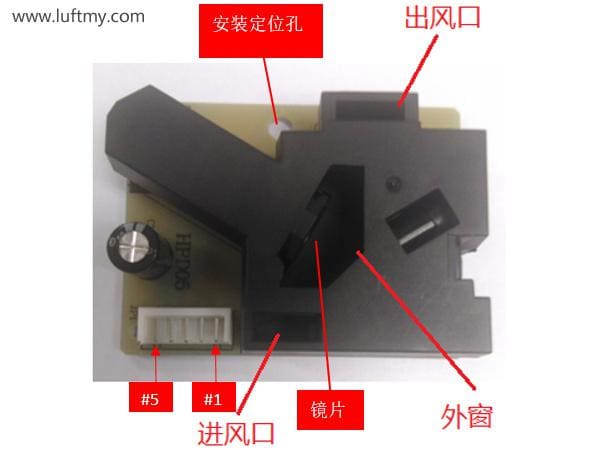
Regarding signal output, the phototransistor inside the infrared sensor can only output Pulse Width Modulation (PWM) signals. This signal cannot intuitively display the concentration of particles in the air and requires further calculation to derive the range of particle concentration. The photoelectric effect of the photodetector inside the laser sensor generates a current signal, which, after circuit amplification and processing, can provide the concentration value of the particles, typically via serial port output.
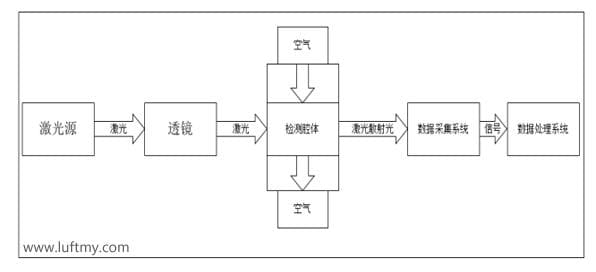
This also explains why some purifiers can only indicate air quality through different colored lights, utilizing infrared dust sensors, while other purification products can display a specific air quality index in digital form using laser dust sensors.
In addition, infrared sensors use resistance heating to drive airflow, resulting in fewer particle samples and slightly insufficient test accuracy. In contrast, laser sensors use fan drive, providing a sufficiently large volume of data collection, which to some extent ensures data accuracy.
LUFMES focuses on optical particulate matter sensor technology research, production, and sales. Its various sensors applied in the field of air purifiers and other equipment have been widely praised in the industry for multiple performance indicators such as measurement accuracy, stability, consistency error, and anti-interference.
