Technical Support:
158-7527-1139


Indoor air pollution is receiving increasing attention, and indoor dust particle density is an important indicator to measure the degree of pollution. PM2.5 refers to particulate matter in the atmosphere with a diameter less than or equal to 2.5 microns, also known as inhalable particulate matter. PM2.5 has a small particle size, is rich in a large amount of toxic and harmful substances, and has a long residence time and long transport distance in the atmosphere, thus it has a great impact on human health and atmospheric environmental quality.
The instant detection of dust particles by PM2.5 sensors is a prerequisite and important guarantee for effective prevention and control of PM2.5 pollution. The PM2.5 dust particle detector can be used for: dust concentration detection at air conditioning exhaust outlets in rooms and cars; atmospheric airborne dust detection by environmental monitoring departments and pollution source investigation; determination of dust concentration at production sites such as construction or blasting; air detection in high-clean production environments such as precision instruments. Application fields of PM2.5 sensor modules developed and produced by particulate matter sensor manufacturer Luftmy: air purifiers, air conditioners with purification functions, PM2.5 detectors, range hoods, smoke alarms, fresh air systems, dedicated PM2.5 sensors, air detectors, etc.
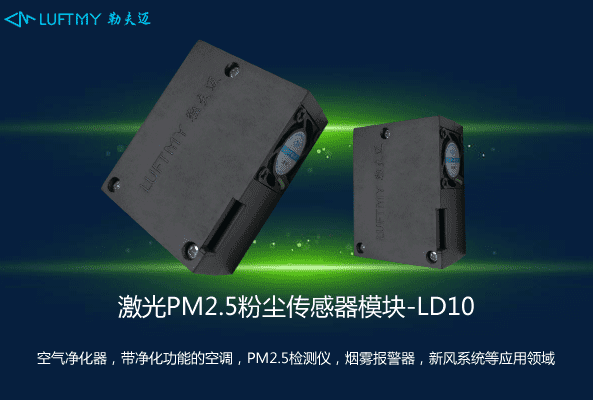
Working principle of laser PM2.5 sensor module LD10: It adopts the Mie spherical particle scattering principle, that is, the laser sensor uses laser irradiation on suspended particles in the air to produce light scattering. The photoelectric detector collects the scattered light intensity within a certain angle range, linearly converts the obtained scattered light intensity into a voltage, and then sends it into the data processing system. The data processing system performs data processing according to a pre-programmed program based on Mie scattering theory to obtain the equivalent particle size of the particles and the number of particles with different particle sizes per unit volume. This sensor can be embedded in various instruments and meters or environmental improvement equipment related to the concentration of suspended particles in the air to provide timely and accurate concentration data.
It can be applied to devices such as PM2.5 dust particle detectors. The PM2.5 dust sensor detects the content of particles in the air with a diameter less than or equal to 2.5 microns in real time, and outputs an analog voltage signal according to the content ratio. After A/D conversion, this signal is collected, calculated, and processed by a microcontroller, and the PM2.5 value is displayed on the LED screen.
Luftmy sensors are widely praised in the industry for their measurement accuracy, stability, consistency error, anti-interference, and other performance indicators.