

Technical Support:
158-7527-1139

In recent years, urban air pollution has seriously affected people's lives, not only resulting in a poor living experience but also potentially impacting physical health if measures are not taken. To have a living environment with good air, urban air governance involves monitoring various concentration data in the air through air quality monitors to formulate improvement measures.

Dust pollution is one of the main problems of air pollution. Dust refers to solid particles suspended in the air for a long time, which can be classified according to standards such as physical and chemical properties and chemical composition. Dust particle size is usually used as the standard for classification. Particles with a diameter greater than 10 microns will quickly fall into the dust due to their own gravity, becoming falling dust. Particles with a diameter of less than 10um have a small proportion in the air and a long suspension time, which is also called suspended dust in environmental science, namely inhalable particulate matter PM10 (particulate matter 10). However, PM2.5 is a fine particle smaller than PM10, with a particle size of 2.5um or smaller, also known as human lung particles, which is more harmful to the human body.
Industrial dust, coal-fired dust, motor vehicle exhaust dust, and construction dust are the main sources of urban dust pollution. The process of urbanization is inevitably accompanied by an increase in energy demand due to industrial development, which indicates that urban dust pollution control faces greater pressure during urbanization. In particular, the sharp increase in the number of motor vehicles has made the proportion of dust in motor vehicle exhaust in urban dust pollution higher and higher. Motor vehicle owners are both victims of pollution and responsible for causing it, which makes controlling urban dust pollution even more difficult.
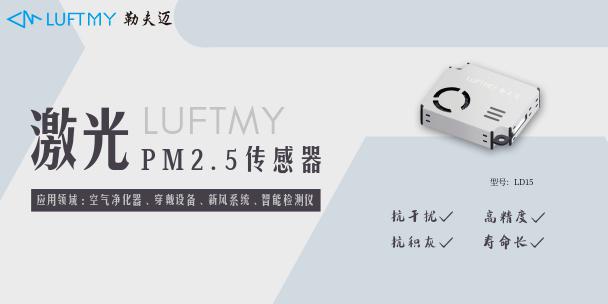
In urban air governance, to accurately understand the dust concentration data in the air, high-precision dust sensors can be used. The laser dust sensors produced and developed by Luftmy can be installed on air quality monitoring related equipment. They can detect dust particles with a particle size range of 0.1~10μm through the Mie spherical scattering principle. This type of dust particulate matter sensor has strong anti-interference ability, high consistency, and the Mean Time Between Failures (MTBF) can be greater than 5 years. In urban air governance, air governance can be carried out through the dust concentration data provided by dust sensors.
