

Technical Support:
158-7527-1139

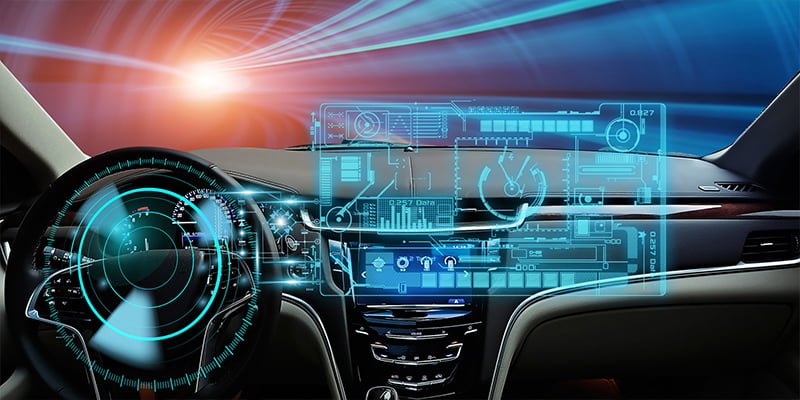
Smart vehicles are a new trend in the development of the automotive industry. With the continuous advancement of technologies such as artificial intelligence and big data, smart vehicles are moving towards high-level autonomous driving, networking, and intelligence.
The iteration of smart vehicles places higher demands on sensors. Sensors serve as the “eyes” and “ears” of smart vehicles, responsible for collecting environmental information around the vehicle to provide a basis for decision-making. Therefore, the performance and quantity of sensors directly affect the safety and reliability of smart vehicles.
Increase in the Quantity and Types of Sensors
Traditional vehicles have fewer sensors, mainly including vehicle speed sensors, RPM sensors, braking sensors, and temperature sensors. In contrast, the quantity and types of sensors in smart vehicles have significantly increased, including cameras, radar, LiDAR, millimeter-wave radar, ultrasonic radar, gyroscopes, accelerometers, and Inertial Measurement Units (IMUs).
Cameras are the most commonly used sensors in smart vehicles, providing image information of the surrounding environment. Radar can detect objects around the vehicle and calculate their distance, speed, and angle. LiDAR can provide 360-degree panoramic images with very high resolution. Millimeter-wave radar can detect close-range objects. Ultrasonic radar can detect obstacles around the vehicle. Gyroscopes detect the rotational motion of the vehicle, and accelerometers detect linear motion. IMUs integrate data from gyroscopes and accelerometers to provide more precise motion information.
Enhancement of Sensor Performance
With technological progress, the performance of sensors is also continuously improving. Camera pixel counts are increasing, providing clearer images. Radar detection ranges are extending further, allowing for the detection of distant objects. LiDAR resolution is getting higher for more accurate imaging. Millimeter-wave radar detection accuracy is increasing to more precisely locate objects. Ultrasonic radar detection distances are getting longer to detect further obstacles. The sensitivity of gyroscopes and accelerometers is also rising to more accurately capture motion information.
Application of Sensor Fusion Technology
A single sensor cannot provide comprehensive environmental information; therefore, smart vehicles need to adopt sensor fusion technology to comprehensively utilize information from multiple sensors. Sensor fusion technology can improve the safety and reliability of smart vehicles while reducing false positive and false negative rates.
Sensors are one of the key technologies for smart vehicles. The improvement in their performance and quantity provides the driving force for the iteration of smart vehicles. In the future, with the continuous development of sensor technology, smart vehicles will become even safer, more reliable, and more intelligent.
