Technical Support:
158-7527-1139

A laser thickness sensor is a sensor that uses laser technology for object distance measurement. It can measure the thickness of an object and convert it into an analog voltage signal or a digital signal. It is composed of a laser transmitter, a laser detector, and a measuring circuit. The principle is to use the opposed-beam method of laser sensors for thickness measurement, placing the sensors on a stable bracket to ensure that the laser beams of the sensors align at the same point. The laser thickness sensor can accurately measure the thickness attributes of the measured object, while also measuring precise geometric values such as position, distance, and diameter.
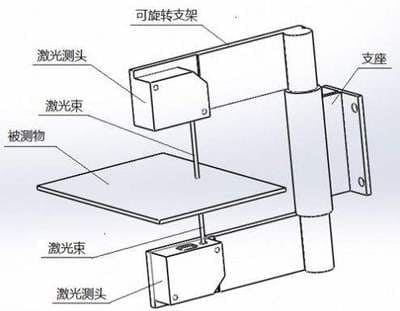
Measurement method of laser thickness sensor——Laser Triangulation Measurement Method.
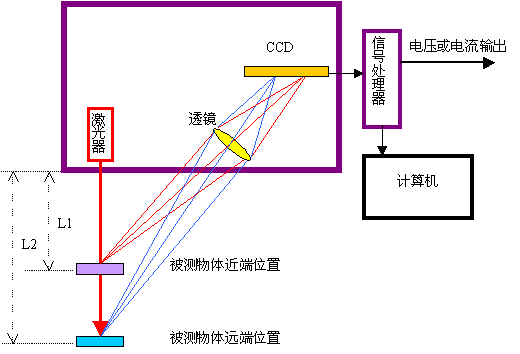
Laser triangulation is suitable for high-precision, short-distance measurements reaching the micron level, with excellent characteristics in detection distance and switching frequency. In laser triangulation, the laser transmitter shoots a visible red laser toward the surface of the object through a lens. The laser reflected by the object passes through the receiver lens and is received by an internal CCD linear camera. Based on the distance of the received reflected light, the CCD linear camera can receive this laser point at different angles. Then, based on this angle and the previously received reflected light distance, the distance between the laser sensor and the measured object is calculated through a digital signal processor.
The laser thickness sensor is applicable for measuring the thickness and width of various materials on production lines. It features non-contact measurement, no damage to the object surface, strong anti-interference ability, high precision, and complete processing functions. It is also applied to thickness measurement of materials such as paper, wood boards, steel plates, and rubber sheets, and is widely used in light industry, machinery, and the steel industry.