

Technical Support:
158-7527-1139

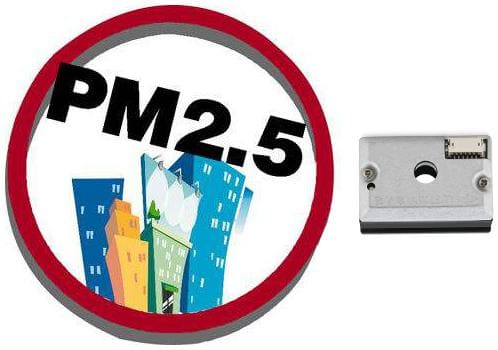
The PM2.5 sensor, also known as a dust sensor, or particle sensor, can detect the concentration of dust particles in the surrounding air. In aerodynamics, dust with a diameter of less than 10 micrometers can directly enter the human alveolar region through the respiratory organs. Dust particles larger than 10 micrometers are deposited through impact, mostly in the nasopharynx. Dust smaller than 10 micrometers enters the respiratory tract, and dust with a diameter of less than 5 micrometers can be deposited directly in the alveoli, which can cause respiratory infections or even lung diseases.
The principle of the PM2.5 sensor involves irradiation with infrared or laser light, obtaining the particle concentration based on the principle of light scattering. Because particles and molecules produce light scattering when irradiated by light, they also absorb part of the energy of the incident light. When a beam of parallel monochromatic light is incident on the measured particle field, it is affected by scattering and absorption around the particles, and the light intensity is attenuated. In this way, the relative attenuation rate of the incident light through the concentration field can be determined. The relative attenuation rate basically reflects the relative concentration of dust in the measured field linearly. The intensity of the light is proportional to the strength of the photoelectric-converted electrical signal; by measuring the electrical signal, the relative attenuation rate can be obtained, and the dust concentration in the field can then be determined.
Inside the PM2.5 type dust sensor, an infrared light-emitting diode and a phototransistor are placed at diagonal positions with intersecting optical axes. When an air stream containing dust passes through the intersection area of the optical axes, the dust in the air stream reflects the infrared light, and the reflected light intensity is proportional to the dust concentration in the air stream. The phototransistor inside the sensor can detect reflected light in the air, allowing even small tobacco particles to be detected. The infrared LED emits light that reflects off dust; the receiving sensor detects the intensity of this reflected light and outputs a signal. The dust concentration is determined by the intensity of the output signal, and the concentrations of different dust particles are distinguished by outputting two different pulse width modulation (PWM) signals.
The HPD05 dust sensor from Guangzhou Luftmy Intelligent Technology Co., Ltd. uses infrared optical methods to detect dust concentration in the air. In the sensor, an IR LED and an image sensor have intersecting optical axes. When a dust-laden air stream passes through the intersection, reflected light is produced. The image sensor detects the IR LED light reflected by the dust and judges the dust concentration based on the output strength. The minimum particle diameter this sensor can detect is 0.5 micrometers, which means it can even detect particles like cigarette smoke.
