

Technical Support:
158-7527-1139


The design principle of the mining laser methane sensor is to use the principle of spectral absorption to measure methane gas concentration. This sensor provides accurate measurement values, strong anti-interference, and can operate for a long time. It is suitable for hazardous environments such as underground coal mines where gas and coal mine explosions may occur.
Working Principle of Mining Laser Methane Sensor:
When the excitation spectrum emitted by the laser is near a certain absorption peak of methane gas, the spectral line width of the laser is set at the corresponding methane absorption peak through temperature control adjustment and current modulation. Then, a modulation signal formed by superimposing sine waves and triangle waves is added to set the spectral line width. Lock-in amplification technology is used to detect the second harmonic signal caused by changes in methane gas concentration, thereby achieving the principle of methane gas concentration detection.
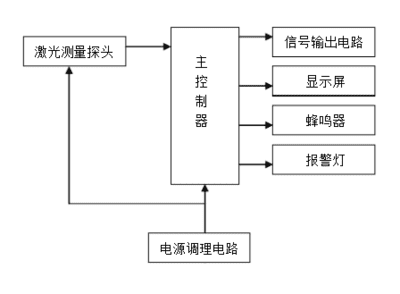
Structure of Mining Laser Methane Sensor:
This type of laser sensor is composed of a laser detection probe, signal processing circuit, main controller, power conditioning circuit, and signal output circuit. The laser detection probe is provided with a stable power supply by the main board, and internal circuits drive the laser tube to produce the characteristic absorption laser of methane gas. After measurement, the laser is received by the detector, the change in laser intensity is calculated by the photoelectric processor, and converted into gas concentration.
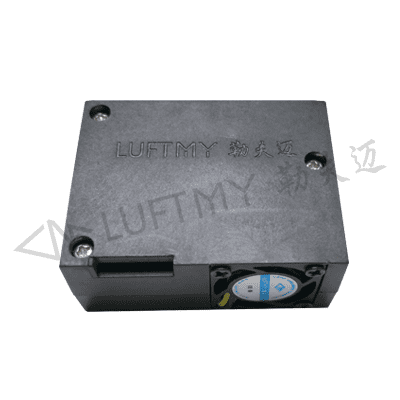
Parameter Characteristics:
1. Working voltage: 9~24V.
2. Working current: ≤100mA/18V DC.
3. Measurement range and basic error: 0.00~1.00%CH4 ± 0.06%CH4; 1.00~100%CH4 ± 6%CH4.
4. Output distance: Frequency signal transmission distance ≥2000m, digital signal transmission distance ≥6000m.
5. Stability: Not less than 180 days.
