

Technical Support:
158-7527-1139

With the development of science and technology, the production and processing of many industrial products put forward high requirements for dust concentration in cleanroom engineering. This requires a certain air cleanliness level in the production environment and controlled supply quality for various related substances needed in the process. For example, in film production, if the film is contaminated by dust, emulsion oxidation, weakened activity, and pH changes will occur, thereby affecting the photosensitive performance of the film. Below, we will introduce the solutions for using dust sensors in cleanrooms for semiconductor integrated circuit production.
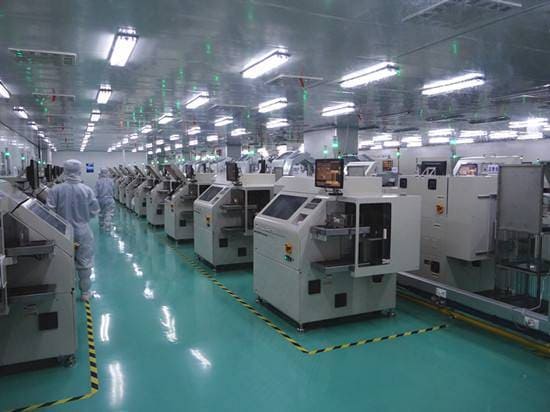
The integrated circuit manufacturing industry is an industry that performs ultra-fine processing using ultra-pure materials in an ultra-clean environment. The purification of semiconductor materials serves as an important foundation for developing semiconductor devices. Due to the process requirements of large-scale and ultra-large-scale integrated circuits, in order to obtain high-purity silicon materials, the cleanliness of the production environment in high-purity and high-precision constant temperature and humidity engineering has become a prominent issue affecting product quality.
The yield rate of integrated circuit chips is related to the chip defect density, which in turn is related to the number of particles in the air. Therefore, the rapid development of integrated circuits not only demands high requirements for controlling the size of particles in the air but also requires further control over the number of particles. At the same time, there are also relevant requirements for chemical pollution control in cleanroom engineering for ultra-large-scale integrated circuit production environments.
Main pollutants that may be encountered during the integrated circuit production process
Main pollutants that may be encountered in integrated circuit production include: particulate impurities, inorganic ions, organic substances, microorganisms, and gaseous impurities. In a broad sense, unsuitable temperature, humidity, illumination, excessive static electricity, electromagnetic noise, air noise, and micro-vibrations are also special pollutants. Among them, when the amount of particulate impurities, inorganic ions, organic substances, microorganisms, and gaseous impurities exceeds a certain limit, phenomena such as surface scratches, pattern disconnection, short circuits, pinholes, and peeling will occur in integrated circuit products, resulting in circuit leakage and abnormal electrical characteristics. Minor cases affect circuit performance and service life, while serious cases can lead to circuit scrapping.
In view of this situation, it is necessary to use dust sensors to monitor the environment of the semiconductor integrated circuit production workshop to ensure that the production environment meets cleanliness standards. Luftmy recommends using the LD13C laser dust sensor, which can detect smoke produced by tobacco, pollen, house dust, etc.
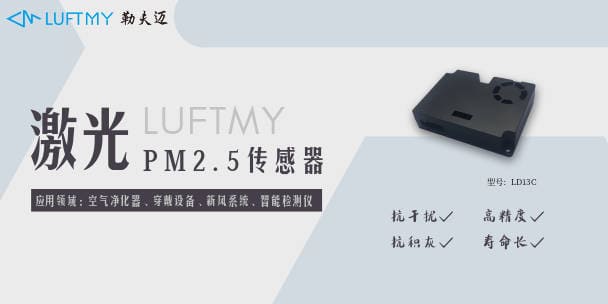
LD13C Laser Dust Sensor
LD13C Laser Dust Sensor Features:
Capable of detecting tiny particles above 0.1 microns;
Small size, light weight, and easy to install;
5V input circuit for easy signal processing;
Electronic control device life ≥ 8 years, MTBF ≥ 5 years;
Simple maintenance, maintaining sensor characteristics over the long term.
