

Technical Support:
158-7527-1139

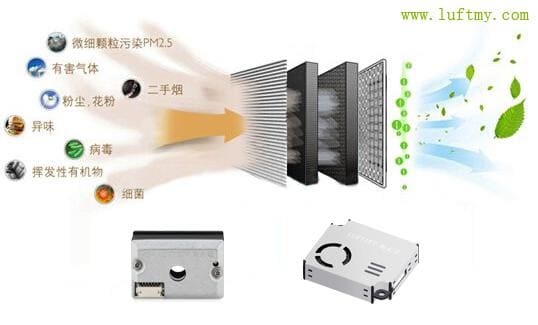
In recent years, the air purifier market in China has been continuously heating up, and many new products have emerged. First, high cost-performance combined with emotional appeal has allowed many newly entered Internet companies to benefit. Second, big data combined with cloud computing gives large companies a strong advantage in intelligence. Specifically, for the smart functions of air purifiers, the PM2.5 sensor is indispensable.
It can be said that the inclusion of dust sensors makes air purifier products appear smarter. Nowadays, most ordinary air purifiers are equipped with dust sensors. Currently, dust sensor detection methods generally fall into two categories: infrared sensor detection and laser sensor detection. Infrared sensors usually measure a range of values rather than precise data, which can only be simulated through algorithms.
Laser sensors, on the other hand, utilize the principle of laser scattering. By scanning air flowing at a uniform speed with a laser, they identify the particle size of airborne particulates based on changes in current and voltage feedback from the laser. Through precise algorithms that account for temperature and humidity, the particle concentration can be converted into mass. The measurement values are accurate, but the price is relatively higher.
Using PM2.5 laser sensors for measurement in air purifiers, the dust sensor can automatically adjust motor speed and airflow based on sensor readings, enabling rapid purification and ventilation. Additionally, by monitoring the air purifier values and detecting the attenuation of the CADR, it can also automatically remind users to replace the filter.
